
Currently Empty: ₹0.00
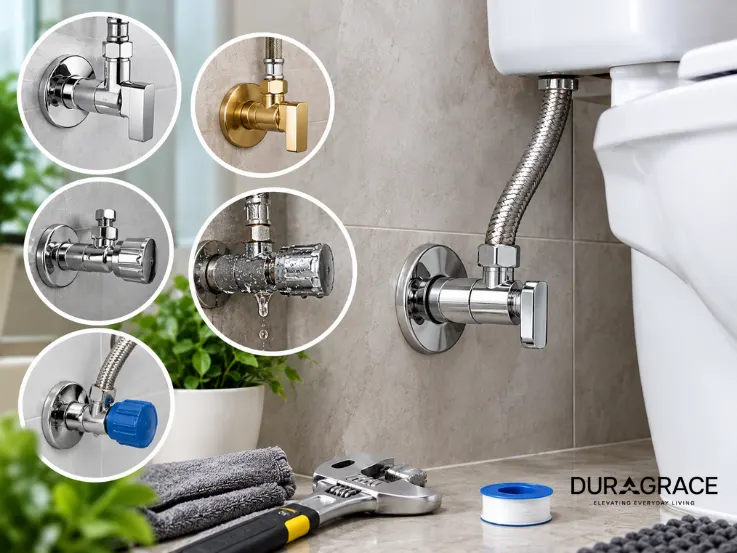
Most people meet an angle valve on the day a tap starts dripping. The plumber arrives, looks under the basin and asks whether there is a way to shut off just that tap. If there is, the repair takes ten minutes. If there is not, the whole flat loses water while someone climbs up to close the tank outlet.
This guide explains what an angle valve does, how many a bathroom really needs, how quarter-turn ceramic valves differ from older washer valves, what a 2-in-1 valve can and cannot do, which size and material to choose, and how to fit, look after and fix one. It also covers the details most guides skip: extension pieces, water hammer, and why an angle valve is built to isolate a fixture, not to fix your water pressure.
Quick answer: how do you choose an angle valve?
Choose a brass angle valve with a quarter-turn ceramic cartridge, usually in the ½-inch size, and fit one for each fixture where you can reach it. It lets you shut off a single basin, toilet, health faucet or geyser without closing the whole supply. A typical attached bathroom needs five or six valves.
Angle valve types at a glance
Type | How it seals | Good for | Watch out for |
|---|---|---|---|
Multi-turn (compression) | A rubber washer pressed onto a seat by several turns of the handle | Fine flow control, older fittings | The washer wears and hardens, causing drips and re-washering |
Quarter-turn, ball | A ball with a hole turns 90 degrees | Fast, tight shut-off on geysers and purifiers | Seal quality varies between makers |
Quarter-turn, ceramic disc | Two ceramic discs line up to open and misalign to close | Daily-use fixtures and hard-water areas | Grit or scale can jam the discs; the cartridge eventually needs replacing |
2-in-1 (two outlets) | One inlet feeding two outlets | A cistern and health faucet from one wall outlet | Some models switch outlets, so only one runs at a time |
General guidance, not specific to one brand. Check the exact model you are buying.
What is an angle valve, and what does it do?
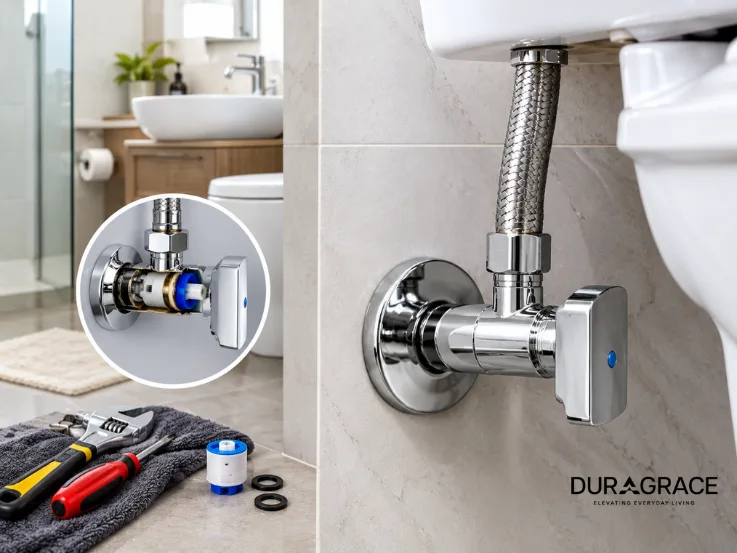
An angle valve, also called an angle cock or angular valve, is a small shut-off valve fitted where a supply pipe leaves the wall and turns 90 degrees towards a fixture. It cuts the water to that one fixture, so you can repair or replace it without closing the main supply or emptying the overhead tank.
Angle cock is the common trade name in India and angle valve is the catalogue term, while DuraGrace lists the same fitting as an angular valve. A stop cock is different: it controls the supply to a whole flat or floor. A ball valve sits inline in a pipe, and a bib cock is a tap.
The Indian Plumbing Association’s plumbing training material lists accessible shut-off valves for each toilet, each dwelling and on the cold supply at or near an appliance (IPA fixtures chapter). It is training guidance, so NBC 2016 and local rules prevail, but it matches the habit of good plumbers: one valve per fixture, within reach.
How many angle valves does a bathroom need?
A typical attached bathroom needs five or six angle valves: two under the basin mixer, one for the toilet cistern, one for the health faucet, one on the geyser’s cold inlet, and one for a washing machine if it sits there. Add one per extra fixture, and keep each valve reachable.
Point | Valves | Why |
|---|---|---|
Basin mixer or two taps | 2 (hot and cold) | Repair one tap without shutting the bathroom |
Toilet cistern | 1 | Service the flush mechanism in isolation |
Health faucet | 1, or shared through a 2-in-1 valve | Isolate the spray; see our health faucet guide |
Geyser | 1 on the cold inlet | Shut off for servicing or travel |
Washing machine, if in the bathroom | 1 | Shut off when you are away |
That adds up to five points, or six with a washing machine. It is a planning example, not a code requirement. In the kitchen, count two for the sink mixer and one each for a dishwasher or water purifier.
Under the basin, these valves share a cabinet with the waste fitting. If you are planning that space, read our bottle trap guide too, so the valves, hoses and trap all stay reachable.
Quarter-turn ceramic or multi-turn washer: which angle valve is better?
Quarter-turn ceramic valves seal with two ceramic discs and need only a 90-degree turn. Multi-turn valves press a rubber washer onto a seat, which gives finer control but wears and hardens over time. Ceramic usually lasts longer, but grit and scale can still jam it, so flush the line when fitting.
Multi-turn (compression). A rubber washer is pressed against a seat as you turn the handle several times. It works, and it allows gradual adjustment, but the washer wears and the seat can score, especially where water is hard or sandy. That means drips and periodic re-washering.
Quarter-turn ceramic. Inside are two ceramic discs with openings. A quarter turn lines the openings up or moves them apart. There is no rubber washer to harden, so the valve tends to stay smooth and tight for years. Kerovit’s plumbing guide notes the one weak point: if debris lodges between the discs, the valve may not close fully, though replacing the cartridge is simple (Kerovit on ceramic cartridges).
Quarter-turn ball. Fast and tight, and popular for geysers and purifiers, but quality depends on the maker.
For daily-use fixtures, a quarter-turn ceramic valve in brass is the safer pick. The DuraGrace Athena Angular Valve is listed with a ceramic cartridge and quarter-turn operation. Whatever you buy, flush the line first, because grit is what damages ceramic.
Which material should an angle valve be?
Choose chrome-plated brass for any angle valve, especially on hot water. Plastic valves can suit a cold-water cistern line but should not feed a geyser. Indian Plumbing Association guidance specifies brass for valves up to 50 mm, and a heavy brass body with an even chrome finish resists corrosion well.
Material | Where it works | Where it does not |
|---|---|---|
Chrome-plated brass | Everywhere, including geyser and hot lines | Cheap, thin plating can wear or blister |
PVC or plastic | Cold-water cistern or basin lines at low pressure | Hot lines; repeated heat shortens its life |
Unplated or low-grade metal | Rarely worth it | Green patina and rust streaks appear early |
Check the plating for an even finish, and check that the thread is clean and the handle turns smoothly before you pay. The DuraGrace Athena pages list a brass body with chrome plating for hot and cold water.
What is a 2-in-1 angle valve, and does it supply both outlets at once?
A 2-in-1 angle valve has one inlet and two outlets, so one wall pipe can feed, for example, a toilet cistern and a health faucet. Some models switch between outlets so only one runs at a time, while others have two handles. Check how your model behaves before you rely on it.
There are three common behaviours. A changeover valve sends water to one outlet at a time. A double-handle valve has a separate control for each outlet. A simple splitter feeds both at once. Ruhe’s 2026 guide describes the changeover type, where only one outlet runs at any moment, while some other guides describe a valve that splits flow to two fixtures. Both exist, so read the specification and ask the seller how that exact model works.
The benefit is fewer holes in the wall and less pipework, which helps in a compact bathroom. The risk is buying one that does not behave the way you planned. If you need the cistern and the health faucet to work independently, a double-handle model or two separate valves is safer. Our health faucet guide explains why the spray should have its own shut-off.
What size angle valve do you need?
Most Indian bathroom fixtures use a ½-inch (15 mm) angle valve, including basins, cisterns and health faucets. Some geysers, washing machines and showers call for ¾ inch (20 mm), so read the fixture’s own inlet size. A bigger valve does not improve flow through a smaller fitting.
Indian sellers’ guides do not agree on geysers (some say ½ inch, others ¾ inch), which is exactly why you should read the fixture’s manual rather than assume. Measure or check the thread of the wall outlet and of the fixture connection before ordering. If the sizes differ, use a bush instead of forcing a fit: DuraGrace lists a CP bush in ½ by ¾ inch for this. The valve then connects to the tap or cistern through a flexible braided connection hose.
Do you need an extension piece?
An extension piece is a short brass tube that extends a wall outlet sitting too deep behind the tile. Fit the shortest piece that brings the thread out enough for the valve to seat properly, because every extra joint is another place to leak. Use PTFE tape on the threads and do not overtighten.
This happens often after tiling: the wall pipe was cut a little short or the tile is thick, so the valve cannot seat against the wall. DuraGrace lists heavy brass extension pieces from 1 to 3 inches. A decorative wall flange then hides the gap where the pipe leaves the tile. Use PTFE tape on every threaded joint that the maker’s instructions say to tape.
How do you install an angle valve?
Close the supply upstream, open a tap to drain the line, then flush the pipe briefly to clear grit. Wrap PTFE tape three or four turns clockwise, screw the valve on by hand, and add a final quarter turn. Open slowly and check every joint with a dry tissue before relying on it.
- Close the supply upstream, at the tank outlet or the riser. If no valve exists upstream, this is the one job where the whole supply has to be off, which is why you fit the valves once and properly.
- Open a tap on that line to drain it.
- Remove the old fitting. Clean the wall thread with a brush and check it for damage.
- Open and close the line briefly to flush out grit before the new valve goes on.
- Wrap PTFE tape three or four turns clockwise around the wall thread, so the tape tightens as the valve screws on.
- Screw the valve on by hand, then give it a final quarter turn with a spanner. More than that risks cracking the wall thread.
- Support the valve body while you tighten the outlet nut, so the wall pipe does not twist. Check the washer is flat.
- Open the supply slowly, open the valve, and check every joint with a dry tissue. Then close the valve and open the tap to confirm it shuts off fully.
A straightforward replacement on an accessible outlet is manageable for a handy homeowner. A seized valve, corroded pipework or concealed lines are plumber jobs, because a mistake behind the tile means breaking it. If you would like to see valves in person, find a DuraGrace store.
Why is my angle valve leaking, and how do you fix it?
A leak at the handle or spindle usually means a worn cartridge or seal, often damaged by scale. Water that keeps flowing when the valve is closed means the seal has failed or debris is stuck between the discs. Replace the cartridge if it is a separate part, otherwise replace the valve.
What you notice | Likely cause | What to do |
|---|---|---|
Handle or spindle drips | Worn cartridge or seal, often from scale | Replace the cartridge if it is separate; otherwise replace the valve |
Water still runs when closed | Failed seal, or grit between the ceramic discs | Flush the line; replace the cartridge or the valve |
Handle stiff or will not turn fully | Scale or a seized spindle | Do not force it; descale or replace |
White crust on the body | Hard-water deposits | Wipe off, then check for a slow leak underneath |
Leak at the outlet nut | Flat or missing washer, loose nut | Re-seat or replace the washer; tighten by hand plus a quarter turn |
Leak at the wall thread | Poor tape or a damaged thread | Close upstream, refit with fresh tape; replace the valve if the thread is damaged |
Green patina or rust streaks | Low-grade metal or worn plating | Replace with a brass valve |
If the valve itself has failed, you cannot use it to isolate the repair. Close the supply upstream instead, and treat a failing valve as a sign to replace it rather than patch it repeatedly.
How do you look after angle valves?
Operate each angle valve fully closed and fully open every few months, slowly, so scale does not seize it. Close quarter-turn valves smoothly, because a fast shut-off can cause water hammer. Close the valves to your geyser, washing machine and water purifier before you travel, so a failed hose cannot flood the house.
- Exercise them. A valve that is never turned can seize in hard water. A slow open and close every few months keeps the spindle free.
- Close gently. A quarter-turn valve closes fast. If you hear a thud in the pipes when you close one, that is water hammer. Close it more slowly. The IPA material calls for pressure-absorbing devices where quick-acting valves are used, so a recurring thud in the whole building is a job for a plumber.
- Keep them reachable. Do not tile over a valve or hide it behind a fixed panel. A valve you cannot reach is a valve you will not use.
- Travel routine. Closing the valves on appliances that hold pressure, such as the geyser and washing machine, removes the most common cause of flooding while you are away.
Can an angle valve reduce water pressure?
Do not rely on an angle valve to fix pressure across the house. Indian Plumbing Association material describes isolation valves as intended to be fully open or fully closed. You can soften a health faucet by closing its valve slightly if the maker allows it, but whole-house high pressure needs a pressure-reducing valve.
Our health faucet guide mentions easing the valve to soften a strong jet. That is a convenience at one fixture, and it is not what an isolation valve is designed for, so check the maker’s advice for your model. For the whole house, the NBC working pressure ceiling is 4.0 bar according to the same IPA material, and a supply near or above that needs a pressure-reducing valve fitted on the line by a plumber. The opposite problem, weak flow from a low tank, cannot be fixed by any valve. It needs height, a larger pipe or a booster pump.
What do DuraGrace angular valves cost?
DuraGrace lists three brass angular valves: Athena at ₹560, Athena Project at ₹494 and Pearl at ₹535, as of October 2026. The Athena pages describe a chrome-plated brass body, a quarter-turn ceramic cartridge and a ½-inch connection for hot and cold water. Compare mechanism and material, not only price.
Valve | What the listing says | Listed price | Original price |
|---|---|---|---|
Brass body, chrome plating, quarter-turn ceramic cartridge, ½-inch connection, hot and cold water; 0.19 kg | ₹560 | ₹675 | |
Brass body, chrome plating, quarter-turn, internal ceramic cartridge mechanism, project-style design; 7 × 3.5 × 11 cm, 0.16 kg | ₹494 | ₹595 | |
Brass angular valve in the same range | ₹535 | ₹645 |
Prices as listed on duragrace.co.in on 27 October 2026, including the site’s current discount. They change, so check the product page.
For context, another Indian seller’s 2026 price guide puts single-outlet brass chrome angle valves at roughly ₹550 to ₹1,200, so these listings sit at or just below the lower end of that band. Add the small parts that make a clean installation: heavy brass extension pieces are listed from ₹95 to ₹270, a CP bush at ₹116 and a wall flange at ₹25.
Final verdict
An angle valve is the cheapest insurance in a bathroom. Fit one per fixture, choose brass with a quarter-turn ceramic cartridge, match the size to the fixture, keep every valve reachable, and turn each one now and then so scale never seizes it. Do that, and a dripping tap becomes a ten-minute job instead of a day without water.
Ready to choose? See the DuraGrace angular valves, or contact DuraGrace to ask about specifications before you order.