Currently Empty: ₹0.00
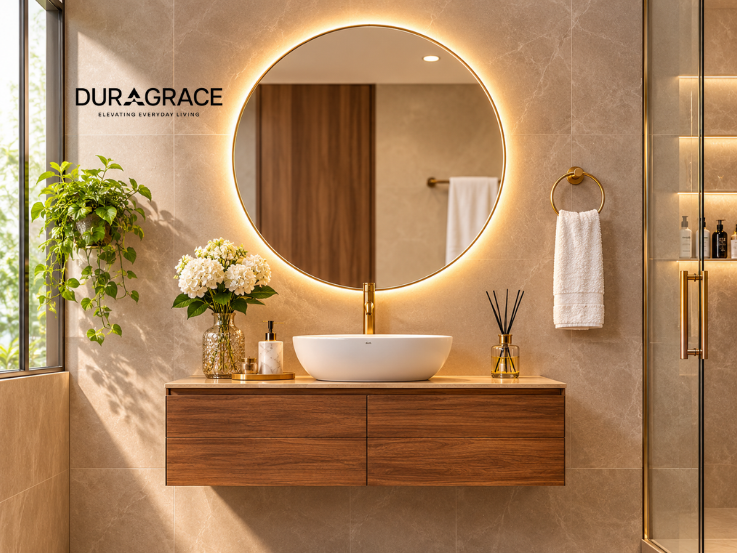
A foggy mirror after a hot shower, a harsh tube light that makes every face look tired, and a mirror too big for the vanity below it. These are the three complaints that send people searching for an LED bathroom mirror, and the answers sit in a few specifications most listings bury.
Prices run from a few thousand rupees for a basic touch-sensor mirror to over ₹25,000 for a smart mirror cabinet, and the photos look almost the same. What separates them is the light quality, the moisture protection and the glass itself.
This guide covers shape, light type, colour temperature, anti-fog, IP rating and sizing for Indian bathrooms, then ends with a checklist you can use in a shop or on a product page. It also shows how to match the mirror frame to the rest of your bathroom fittings.
Quick answer: For most Indian bathrooms, choose an LED bathroom mirror with front or dual lighting, a neutral 4000K colour (or a 3000K to 6000K switch), CRI 90 or higher, at least IP44 protection and a proper anti-fog pad if your showers are hot. Match the width to your vanity, and ask what silvering the glass uses.
What Is an LED Bathroom Mirror and How Is a Smart Mirror Different?
An LED bathroom mirror is a wall mirror with built-in LED lighting, usually switched by a touch sensor. A smart bathroom mirror adds extras such as an anti-fog pad, colour-temperature switching, a clock or Bluetooth. A mirror cabinet adds storage behind the glass.
|
Type |
What you get |
Best for |
|
Plain mirror |
Glass only, lit by a separate light |
Tight budgets, rented homes |
|
LED mirror |
Built-in lighting, touch switch |
Most family bathrooms |
|
Smart mirror |
LED plus defogger, colour switching, sometimes clock or Bluetooth |
Hot-shower households, grooming-heavy use |
|
Mirror cabinet |
Mirror with shelves behind, often with LED |
Small bathrooms short on storage |
More features mean more electronics that can fail in a humid room. Buy the features you will use daily, not the longest list.
Which Shape Is Best: Round, Oval, Arch or Rectangle?
Round, oval and arch mirrors soften the hard lines of tiled bathrooms, while rectangular mirrors give the most usable surface over a wide vanity. Choose the shape that suits your vanity width and wall, then check that the lit area still covers your face.
|
Shape |
Effect |
Works well when |
|
Round |
Soft, friendly, a focal point |
A single basin on a plain wall |
|
Oval |
Elegant, slightly formal |
Narrow vanities, narrow walls |
|
Arch |
Modern, adds height |
Plain walls where you want a design feature |
|
Rectangle |
Largest reflecting area, easy to match to the vanity |
Wide vanities, double basins |
Round and arch shapes can look small if the vanity is wide. Match the mirror width to the vanity first, then pick the shape.
Front-Lit, Backlit Halo or Dual-Lit: Which Is Right?
Front-lit mirrors put light on your face, which is best for shaving and makeup. Backlit (halo) mirrors glow around the edge and give a soft spa ambience but less face light. Dual-lit mirrors combine both, so one mirror serves grooming and mood lighting.
- Front-lit: the best choice if you groom at the mirror every day.
- Backlit halo: the best choice for atmosphere, and for guest or powder rooms where grooming matters less.
- Dual-lit: the safest pick if one mirror has to do both jobs.
Which Light Colour and CRI Should You Choose?
Choose 4000K, neutral white, for everyday grooming, and 3000K, warm white, for a softer evening mood. A mirror that switches between 3000K and 6000K gives you both. Look for a Color Rendering Index (CRI) of 90 or above so skin tones and makeup look true.
Colour temperature (CCT) is measured in Kelvin. Low numbers look yellow and cosy, high numbers look blue-white and sharp. CRI shows how accurately the light shows real colours. If a listing does not state CRI, treat it as unknown and ask the seller, because a low-CRI mirror can make makeup and shaving results look different in daylight.
Do You Need an Anti-Fog Mirror?
You need an anti-fog bathroom mirror if your family takes hot showers with the door closed, because steam fogs glass within minutes. A built-in defogger pad warms the glass slightly so the mirror stays clear. If fog is rare, a simpler LED mirror is cheaper and has fewer parts.
A heated defogger pad is usually the more reliable way to stop fog. Some smart mirrors tie the defogger to the light switch, while others give it a separate switch. A separate switch is useful, because you can run only the defogger during a shower and save the lighting for grooming. Ask how the defogger is powered and what the warranty covers.
What IP Rating and Wiring Does a Bathroom Mirror Need?
Choose at least IP44, which protects the electrics against water splashes. The mirror usually sits near a basin, where splashes are common. Ask a qualified electrician to wire it, and ask whether the circuit has residual-current protection. Do not rely on a plug point that sits within splash reach.
Higher IP ratings suit spots nearer to showers. Do not place a mirror inside a wet shower zone unless the manufacturer states that it is made for it. Always follow the maker’s installation notes and keep the power supply away from direct water.
What Should You Ask About the Mirror Glass?
Ask what silvering is used and whether the back is protected, because humid air attacks the edges of cheap mirrors first and leaves black spots. Quality silvered glass mirrors in India are covered by IS 3438, so ask whether the mirror meets it and what warranty applies.
Black edges are the most common reason a good-looking mirror is replaced early. Copper-free silvering and a sealed back protect the reflective layer from moisture. The frame, shape and lighting are visible in photos. The glass quality is not, so ask for it in writing.
What Size Mirror Fits Your Vanity?
As a rule of thumb, choose a mirror about as wide as the vanity or slightly narrower, and centre it on the basin. A mirror much wider than the vanity looks top-heavy, and one much narrower looks lost. Hang it so the centre sits near the eye level of the person who uses it most.
|
Vanity width |
Suggested mirror width |
Notes |
|
600 mm (about 24 in) |
About 500 to 600 mm |
Round or oval works well |
|
800 mm (about 31 in) |
About 600 to 800 mm |
Rectangle or arch works well |
|
Double basin |
Wide rectangle, or two mirrors |
Space the mirrors evenly over each basin |
These are guidelines, not standards. Cut a cardboard template to size and tape it to the wall for a day to judge the effect before you buy.
Frameless or Framed: How Do You Match the Mirror to Your Fittings?
Choose a thin metal frame in the same finish as your accessories for a matched look, or a frameless mirror if your wall is heavily textured or busy. A mirror frame counts as a metal finish, so it should follow the dominant finish in your bathroom.
If your accessories are gold or rose gold, a thin gold or rose gold frame repeats the finish and makes the set look planned. If you use matte black, a thin black frame does the same. Our matte black accessories guide and the small bathroom accessories guide help you pick pieces that do not crowd the wall.
How Much Does an LED Bathroom Mirror Cost in India?
LED bathroom mirrors in India are listed from a few thousand rupees for basic touch-sensor models to over ₹25,000 for smart mirror cabinets with anti-fog and touch controls. Branded smart mirrors with a defogger and colour switching are often listed in the ₹8,000 to ₹12,000 range.
|
What drives the price |
Why it matters |
|
Light quality (CRI, even spread) |
Better LEDs and diffusers cost more |
|
Anti-fog pad |
Adds a heating element and a switch |
|
IP rating and driver quality |
Better sealing and electronics cost more |
|
Glass quality and backing |
Copper-free silvering and sealed backs cost more |
|
Size and shape |
Larger and arch or round shapes use more material |
|
Warranty |
Longer warranties cost the maker more |
Prices are from search results of brand and marketplace listings in November 2026 and change quickly.
Where Does DuraGrace Fit?
A mirror works best as part of the whole vanity wall. DuraGrace lists wall-mounted vanities in HDHMR board, a moisture-resistant material, in sizes such as 600 mm and 800 mm, and PVD gold, rose gold, black matt and chrome bath accessories to match your mirror frame.
For example, the Woodworks-6003 vanity is a 600 mm wall-mounted unit listed at ₹19,648, and the Regal Beauty-8017 is an 800 mm unit listed at ₹45,496 (displayed prices, 23 November 2026). Pick the vanity first, because its width decides the mirror size.
Warm-metal accessories to pair with a framed mirror are in the Gracia Rose Gold and Flute Gold ranges. Not sure what suits your wall? Contact DuraGrace with your vanity width and a photo of your bathroom.
Eight-Point Checklist Before You Buy an LED Bathroom Mirror
- Size. Match the width to the vanity and test with a cardboard template.
- Light type. Front-lit or dual-lit if you groom at the mirror.
- Colour temperature. 4000K, or a 3000K to 6000K switch.
- CRI. 90 or higher, stated in the listing.
- Anti-fog. A separate defogger pad if your showers are hot.
- IP rating. At least IP44, with proper wiring by an electrician.
- Glass. Ask about silvering, back protection and IS 3438.
- Warranty. Ask what covers the LED, the driver, the defogger and the glass, and get it in writing.
How Do You Clean and Care for an LED Mirror?
Switch the mirror off at the supply, then wipe it with a soft, slightly damp microfibre cloth and a mild glass cleaner applied to the cloth, not sprayed on the mirror. Keep liquid away from the edges and the LED strip. Dry it fully, and never use abrasive pads.
Water that creeps behind the glass is what causes black edges and electrical faults. In hard-water areas, wipe off splashes after each shower so mineral spots do not build up.
Buy Bathroom Fittings Online India: A Safe-Buying Note
When you buy bathroom fittings online India listings often omit the details that matter for a mirror: CRI, IP rating, glass silvering and warranty scope. Buy from the manufacturer or an authorised dealer, save the specification page, and confirm the return window before ordering. Premium bathroom accessories and mirrors should state their specifications clearly.
To see finishes in person, use the store locator, and check the current offers.
Conclusion: Buy the Light, the Glass and the Fit
A good LED bathroom mirror is judged on light quality, moisture protection and glass, not on the shape in the photo. Choose a neutral colour temperature with CRI 90 or above, at least IP44, an anti-fog pad if your showers run hot, and a width that suits your vanity. Then match the frame to your accessories. Start with the DuraGrace vanity range, or talk to the team for help planning the wall.
Frequently Asked Questions About LED Bathroom Mirrors
What is the best colour temperature for a bathroom mirror?
For everyday grooming, 4000K neutral white is a balanced choice. 3000K warm white gives a softer evening mood, and 6000K daylight suits precise tasks such as shaving. A mirror that switches between 3000K and 6000K lets you use all three.
What is CRI and why does it matter for a mirror?
CRI, or Color Rendering Index, shows how accurately a light shows real colours. For a bathroom mirror, 90 or above is a good target, so skin tones and makeup look true. If a listing does not state CRI, ask the seller before you buy.
Do I need an anti-fog LED mirror?
You need one if your family takes hot showers with the door closed, because steam fogs glass quickly. A built-in defogger pad keeps part of the mirror clear. If fog is rare, a simpler LED mirror costs less and has fewer parts that can fail.
What IP rating should a bathroom mirror have?
At least IP44, which protects against water splashes, is the usual minimum for a mirror near a basin. Ask a qualified electrician to wire it, ask about residual-current protection on the circuit, and follow the manufacturer’s notes for any wet area.
How big should my bathroom mirror be?
As a rule of thumb, choose a mirror about as wide as the vanity or slightly narrower, centred on the basin. For a 600 mm vanity, roughly 500 to 600 mm works well. Tape a cardboard template on the wall to judge the effect first.
Which mirror shape suits a small Indian bathroom?
Round and oval mirrors soften hard tile lines and suit narrow vanities. Rectangular mirrors give the most reflecting area. Choose the width to match your vanity first, then the shape, and check that the lit area still covers your face.
How much does an LED bathroom mirror cost in India?
Listings in November 2026 range from a few thousand rupees for basic touch-sensor models to over ₹25,000 for smart mirror cabinets. Branded smart mirrors with a defogger and colour switching are often listed around ₹8,000 to ₹12,000. Prices change quickly.
Why do bathroom mirrors get black edges?
Moisture reaches the reflective silver layer at the edges and attacks it, especially on cheap mirrors with poor back protection. Copper-free silvering and a sealed back slow this down. Wipe splashes off the edges and ask the seller about the glass.