
Currently Empty: ₹0.00
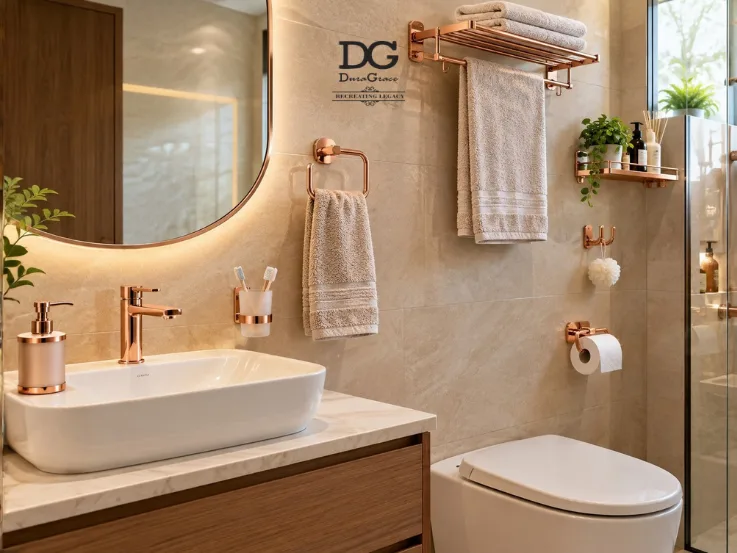
Quick Answer
In a small bathroom, the right accessories do more work than extra furniture ever could. Start with five: a wall-mounted liquid soap dispenser, a towel rack or rod placed where it can air-dry, two or three robe hooks, a corner or wall shelf for daily products, and a toilet roll holder within easy reach. Choose SS304 or quality brass with a durable finish over cheap plated alternatives, mount everything at the right height, and drill rather than rely on adhesives in wet zones. That combination clears the counter, keeps things dry, and lasts years instead of months.
The Accessories That Matter Most (Priority Order)
Most guides hand you a list of 16 or 39 items. In a small bathroom, you don’t need that many. This is the order in which accessories add the most function:
- Wall-mounted liquid soap dispenser. Clears the sink edge of bottles and stops soap sitting in a puddle.
- Towel rack or towel rod. The single most-used accessory. It needs a spot where towels can dry, not just hang.
- Robe hooks (two or three). Cheap, tiny, and they take pressure off the towel rack.
- Corner or wall-mounted shelf. Holds shampoo, face wash and daily products off the floor and counter.
- Toilet roll holder. Placed correctly, it’s invisible; placed badly, it’s a daily annoyance.
- Tumbler holder. Optional but useful if you want brushes and cups off the sink.
- Mirror cabinet or mirror with shelf. Adds storage without adding footprint.
If your budget is limited, buy items 1 to 4 first and add the rest later. Those four remove the most clutter per rupee.
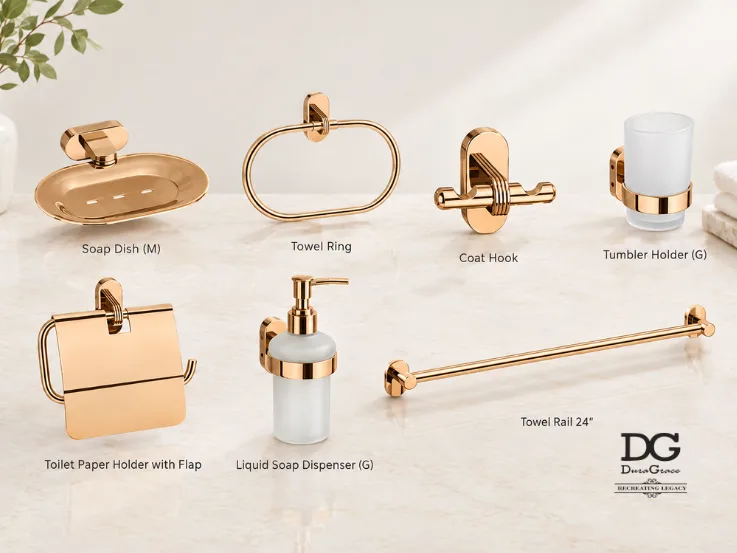
Material Guide: What “Rust-Proof” Actually Means
Almost every listing claims to be rust-proof. In practice, the base material decides how an accessory behaves in Indian humidity, monsoon moisture and hard water.
| Material | How it holds up | Watch out for |
|---|---|---|
| SS304 stainless steel | Excellent corrosion resistance; the standard for long-life bathroom accessories | Cheaper “stainless” that isn’t 304 can spot and rust; ask for the grade |
| Brass (chrome or coated) | Very durable, heavy, holds screws well | Quality depends on the plating; thin plating wears at contact points |
| Zinc alloy | Good for decorative pieces and detailed shapes | Plating wear and corrosion can appear sooner in constant wet zones |
| Aluminium | Lightweight, resists rust, suits modern minimalist designs | Softer; can dent and may oxidise or dull under harsh cleaners |
| Plated plastic / ABS | Cheapest option | Plating peels and the body can crack; best avoided in wet zones |
Two practical rules. First, the finish matters as much as the metal: a good base metal with thin plating will still show wear at the edges and screw points. Second, hard water leaves mineral deposits on any material; regular wiping matters more than the material itself for keeping surfaces looking new. For a bathroom you want to stay untouched for a decade, SS304 or well-plated brass are the safer categories.
Where to Install Each Accessory (Heights & Clearances)
Placement is what separates a functional accessory from one you knock into. These are commonly used working ranges; adjust for household height and your own layout.
| Accessory | Typical height from floor | Notes |
|---|---|---|
| Towel rod / rack | 120–135 cm | Keep it within arm’s reach of the shower exit, ideally away from direct splash |
| Robe hooks | 150–170 cm | Behind the door or on a side wall; stagger two heights for different users |
| Toilet roll holder | 60–70 cm | On the side wall, roughly 20–30 cm ahead of the front of the toilet bowl |
| Wall soap dispenser | 100–110 cm (or about 20–25 cm above basin edge) | Position so the nozzle sits over the basin, not the counter |
| Shelf (daily products) | 100–140 cm | Within easy reach; keep clear of direct shower spray |
| Tumbler holder | 105–115 cm | Beside the mirror or basin, at comfortable reach |
Two clearance checks before you drill anything: make sure the door swing doesn’t hit a towel rod, and confirm no accessory sits where a seated person’s elbow or a standing person’s shoulder will catch it. In a small bathroom, two or three centimetres of poor placement is felt every day.
Drilling vs Adhesive: An Honest Comparison
Adhesive and suction accessories are heavily promoted for small bathrooms, mainly because they’re easy. They also have real limits.
- Adhesive/suction: Fine for very light items in dry zones (a hook for a light hand towel outside the splash area). On wet, soapy or textured tile, adhesion weakens over time, especially with heat, steam and hard-water film. Heavy, wet towels are the usual cause of failures.
- Drilled and screwed: Far more secure for anything that carries real weight: towel racks, shelves, robe hooks that hold wet robes. It takes more effort, but it’s a one-time job.
For anything you’ll lean on, hang wet towels from, or load with bottles, drill. Reserve adhesive options for genuinely lightweight, low-splash use.
How to Drill Bathroom Tile Safely
- Check for concealed pipes and waterproofing. Avoid drilling directly above or below visible plumbing lines, and don’t drill in areas near a recessed shower mixer without confirming pipe routes with your plumber or the bathroom plan.
- Mark the position and use masking tape over the spot so the drill bit doesn’t skate across the glaze.
- Use a tile or masonry bit and start slowly, without hammer action, until the glaze is through. Then switch to a gentle setting for the wall behind.
- Insert a proper wall plug and use corrosion-resistant screws (stainless steel), so the fixing doesn’t rust and stain.
- Seal the screw holes with a little clear silicone where the accessory meets the tile in wet zones, to stop water seeping behind.
If you’re renovating, decide accessory positions before tiling is finished. It’s far easier to plan fixings than to drill afterwards.
Why a Wall-Mounted Soap Dispenser Works Better in Small Bathrooms
Bar soap in a small bathroom tends to sit in a puddle, leave residue on the counter and get shared between users. A wall-mounted liquid soap dispenser solves all three: it clears the counter, keeps the nozzle above the basin so drips fall where they should, and needs no dish or holder. In a compact space, removing three or four bottles and dishes from the sink edge changes how the whole room feels. Choose one with a rust-resistant body and a refillable design, and mount it so the nozzle sits over the basin.
Towel Placement, Airflow and Mould
In humid Indian conditions, a towel that can’t dry becomes a source of odour and mould. Two simple rules help:
- Give towels airflow. A towel rod or open rack lets air move around the fabric, drying faster than a towel folded onto a closed shelf or hung tight on a hook.
- Keep towels out of direct splash. Place the rod on a wall you don’t spray when showering, or near the exit rather than inside the shower zone.
If space allows only one rack, consider a two-bar or double-layer rack. It doubles capacity without needing extra wall width.
Matching Finishes Without Overthinking It
You don’t need every item to be identical, but a consistent finish makes a small room look intentional rather than cluttered.
- Match accessories to your tap and shower finish (chrome with chrome, matte black with matte black). This is the most visible pairing.
- Limit yourself to one finish, two at most. Mixing three finishes in a small space looks busy.
- Match the finish family to your vanity hardware if you have a vanity, so handles and accessories feel like one set.
Chrome and brushed steel tones are the safest, most forgiving choices; darker finishes look striking but show water marks and hard-water spots more readily, so they need slightly more wiping.
A Sample Setup for a 5 x 7 ft Bathroom
For a typical compact Indian bathroom, this arrangement covers daily needs without crowding:
- Basin wall: wall-mounted soap dispenser, tumbler holder, and a mirror (or mirror cabinet) above.
- Shower-adjacent wall: a corner shelf for shampoo and body wash, kept out of direct spray if possible.
- Wall by the door: a towel rod placed to catch airflow, with two robe hooks above or beside it.
- Toilet side wall: a toilet roll holder at the right height and distance.
That’s five to six accessories total. Each has a job, nothing sits on the floor, and the counter stays clear.
Common Mistakes to Avoid
- Buying on looks and ignoring the base material. A beautiful finish over a weak base metal shows wear within a year or two in humid conditions.
- Using adhesive fixtures for heavy or wet loads. Wet towels and full bottles are what make them fall.
- Installing at random heights. A towel rod at the wrong height or a toilet roll holder too far back is a daily irritation you can’t easily fix after tiling.
- Overfilling the walls. In a small bathroom, fewer well-placed accessories look and work better than many crammed ones.
- Ignoring door swing and elbow room. Always check clearances before drilling.
- Mixing too many finishes and making a small room look cluttered.
Final Verdict
The best small-bathroom accessory setup isn’t the one with the most items. It’s the one where five or six well-chosen pieces are made from materials that survive Indian humidity, mounted at heights that suit daily use, and fixed with screws rather than hope. Start with the soap dispenser, towel rack, hooks and a shelf, get the heights right before you drill, and match the finish to your taps. Do that, and a small bathroom starts to feel organised and larger without changing a single tile.