
Currently Empty: ₹0.00
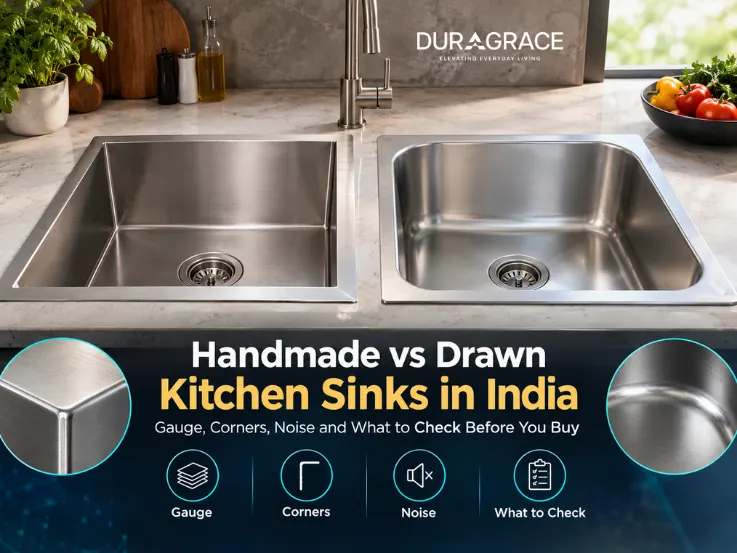
Two stainless steel sinks can look almost the same in a showroom and behave very differently after two years of daily cooking. One was pressed from a single sheet in seconds. The other was cut, folded and welded by a fabricator. They are priced differently for a reason, and the reason is not only looks.
This guide explains the real differences between a handmade (handcrafted) sink and a drawn (pressed) sink: how each is made, what gauge and “R10 corners” actually mean, why handmade sinks are usually quieter, and a seven-point check you can run in a shop or on delivery day. It also covers something most buying guides skip: stainless steel sinks sold in India now come under a BIS quality-control order, so the ISI mark is worth looking for.
Quick answer: handmade or drawn?
Choose a handmade (handcrafted) sink if you cook daily, wash large vessels and want a deeper bowl, square corners and heavier steel, typically 1.2–1.5 mm. Choose a drawn (pressed) sink for rentals, secondary kitchens or tighter budgets. Either way, insist on SS 304, a stated thickness and the ISI mark.
Handmade vs drawn sink: quick comparison
Feature | Handmade (handcrafted) | Drawn (pressed) |
|---|---|---|
How it is made | Sheets cut, folded and TIG-welded | One sheet pressed into a die |
Typical thickness* | 1.2–1.5 mm (16–18 gauge), even across the bowl | Commonly 0.6–1.0 mm, thinner at corners and base after pressing |
Corners | Tight: R0 to R10 | Wide, rounded radius |
Usual bowl depth | About 9–10 inches | About 7–9 inches |
Noise | Quieter with undercoat and pads | Can ring if thin or uncoated |
Cleaning | Corners need a soft brush | Easiest to wipe |
Rigidity | High, resists denting | Thin bases can flex |
Typical installation | Often undermount or flush-mount | Usually top-mount |
Cost | Higher | Lower |
What is the difference between a handmade sink and a drawn sink?
A drawn sink is pressed from one stainless steel sheet into a die, which stretches the metal and thins the corners. A handmade sink is built from separate sheets that are cut, folded and welded, so the thickness stays even. Both are stainless steel; the difference is how the bowl is formed.
Handmade, handcrafted, fabricated and hand-carved all describe the same category. Drawn, pressed, hydraulic and machine-made describe the other. Some listings compare a “handmade sink vs stainless steel sink”, which is misleading, because handmade sinks are stainless steel too.
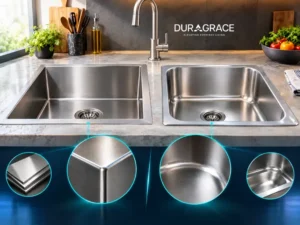
How a drawn sink is made
In deep drawing, a flat blank of stainless steel is clamped over a die and a hydraulic punch pushes it down to form the whole bowl in one stroke. The steel has to flow into the shape, so it stretches. The areas that stretch most, the corners and the lower walls, finish thinner than the sheet you started with.
The upside is speed and consistency. Drawn sinks are cheaper, easy to find, and have no weld seams to clean around.
How a handmade sink is made
A handmade sink starts as flat sheets that are laser-cut or sheared, folded on a bending press and joined by TIG (tungsten inert gas) welding. The seams are ground and polished until they sit flush with the surface. Because the steel is bent rather than stretched, the thickness stays the same across the bowl, and the corners can be made tight and square.
Quality depends heavily on the fabricator. A good weld is almost invisible. A poor one leaves ridges, pinholes or dark heat marks. The checklist further down shows how to spot the difference.
How thick should a kitchen sink be? Gauge and millimetres explained
For daily Indian cooking, aim for 1.2 mm (18 gauge) or thicker in SS 304. Handmade sinks commonly use 1.2–1.5 mm sheet, while drawn sinks often use 0.6–1.0 mm. A lower gauge number means thicker steel, and thickness matters most at the corners and base, where heavy vessels land.
Gauge is a numbering system for sheet thickness, and it runs backwards: 16 gauge is about 1.5 mm, 18 gauge about 1.2 mm and 20–22 gauge about 0.8–1 mm. We cover the full gauge table, and why SS 304 and SS 202 are not the same steel, in our 304 stainless steel vs quartz kitchen sink guide. Read it before you compare prices.
Why the number on the box may not be the thickness at the corner
When a drawn sink is sold as “1 mm”, that figure often describes the flat sheet before pressing. Deep drawing stretches the steel as it flows into the die, so the corners and lower walls can finish thinner. A handmade sink does not have this problem, because the sheet is bent, not stretched.
So two sinks both labelled “1.2 mm” are not automatically equal. Ask whether the figure is the starting sheet or the finished sink. If a pressed sink flexes under your thumb, or the base pops when you press it (called oil-canning), the steel is too thin for heavy use.
How to check thickness yourself
The cut edge of the drain hole is the easiest place to measure, because it shows the thickness of the base. A vernier calliper or micrometre reads it in seconds, and both appear in the equipment list in the BIS product manual for IS 13983. With no tools, knock the base with a knuckle. A dull thud suggests thicker, damped steel. A bright ring suggests thin, undamped steel. Treat this as a rough hint, not proof.
What does R10 mean, and are sharp-cornered sinks harder to clean?
R10 means the inside corner has a 10 mm radius. Handmade sinks use R0 (almost square) to R10 corners, which gives a flatter floor and more volume than a drawn sink’s wide curves. The trade-off is cleaning: tight corners hold residue, so they need a soft brush.
The radius is how rounded a corner is, so a bigger number means a rounder corner. Pressed sinks usually cannot be formed with very tight corners without the steel tearing, which is why they have wide, sloping curves. Folded and welded sinks can be made nearly square.
What tight corners really give you: volume, not pot room
A round kadai or handi sits on its curved base and does not reach into the corners, so square corners do not help a round pot fit. What they add is flat floor area and extra volume for the same outside size. That helps with rectangular trays, chopping boards, large thalis and stacked utensils, which matters in a household that washes a lot after every meal.
Before you buy, compare the sink’s inside bowl size with your largest vessel, handles included. A catalogue size such as 24×18 inches may describe the outer size including the rim, so ask the seller for the inside bowl dimensions.
Keeping square corners clean
Rinse after cooking and wipe the corners with a soft nylon brush or cloth. Avoid steel wool, which dulls the finish and traps grime. R10 is a practical middle ground: you keep most of the extra volume and the corners are easier to wipe than near-square R0.
How deep should a kitchen sink be?
Most handmade sinks are about 9–10 inches deep and most drawn sinks 7–9 inches. A deeper bowl contains splashes and hides stacked vessels, but it means more bending and needs more cabinet clearance below. Match depth to your height, your tap and your under-sink plumbing.
If you are shorter, a 10-inch bowl means reaching further down for every dish, so test the depth at the counter if you can. Check the space under the counter for the bowl, trap and waste pipe, especially if you plan a water filter or RO unit below. Depth varies even within one range: the DuraGrace 304C sink lists both 8-inch and 10-inch single-bowl options.
Why are handmade sinks quieter? How noise dampening works
Noise comes from vibration. Thicker steel vibrates less, and handmade sinks usually add an undercoat on the underside plus rubber or foam pads on the base and sides. Together they absorb the drumming of running water and the clang of steel utensils. Thin, uncoated sinks tend to ring more.
Not all dampening is equal. A thin spray coat does little. A thicker undercoat with pads covering the base and sides does more. Ask what the dampening is made of and where it is applied. DuraGrace’s Hand Crafted Sink lists sound-deadening technology among its features.
A knock test helps: tap the base and the side walls. A dull thud suggests good damping. It is only a rough check, because a sink sounds different once it is fitted in a counter. If silence is your top priority, quartz is quieter than any steel sink, as our steel vs quartz comparison explains.
How to check a handmade sink before you buy: a 7-point checklist
Check seven things: steel grade and thickness in writing, weld seams that sit flush with no pinholes or dark marks, straight edges, a base that slopes to the drain, undercoat and pads on the base and sides, an even finish, and the ISI mark. A seller who cannot answer these should not get your order.
- Grade and thickness in writing. The invoice or spec sheet should say SS 304 and give the thickness in mm. “Stainless steel” alone tells you nothing.
- Weld seams. Run a finger along every seam. It should feel smooth and flush. Reject ridges, pinholes, cracks, or blue and brown discolouration (heat tint) around the weld, which points to poor welding and weaker corrosion resistance at that spot.
- Edges and rim. Edges should be straight and the rim flat. Lay a steel scale along the rim: gaps or waves mean poor fabrication, and they will cause trouble at installation.
- Base slope and grooves. The base should lead water to the drain, usually through embossed grooves. A flat base leaves pools that cause water spots and food film.
- Dampening. Look under the bowl for undercoat and pads covering the base and sides, with no bare patches.
- Finish. The satin or matte finish should be even, with no scratches or patchy polish, especially near the welds.
- ISI mark and markings. See the next section. You can also check a sink in person at a DuraGrace store.
Is a handmade sink BIS (ISI) certified? What IS 13983 means
IS 13983:1994 is the Bureau of Indian Standards specification for stainless steel sinks for domestic use, covering materials, dimensions, construction and finish. A government quality-control order has phased in mandatory certification, with enforcement starting October 2025. Look for the ISI mark and ask for the licence number.
According to a compliance summary of the notified order (S.O. 3850(E), dated 21 August 2025), enforcement applies from 1 October 2025 for larger manufacturers, 1 January 2026 for small enterprises and 1 April 2026 for micro enterprises, with exemptions for goods made only for export. Rules and dates can change, so confirm the current position on the BIS website.
As a buyer, look for the ISI mark on the sink or its packaging, ask for the licence number, and ask whether the exact model you are buying is covered. The mark is a useful baseline. It is not a substitute for asking for the actual grade and gauge of the sink in front of you.
Handmade or drawn: which is better for Indian cooking?
For daily cooking with large kadais, handis and pressure cookers, a handmade SS 304 sink at 1.2 mm or thicker is the more durable choice. For rentals, utility kitchens, light use or tight budgets, a good drawn sink is sensible. The right pick depends on workload, budget and installation.
Choose a handmade sink if
- You cook daily and wash large vessels, rectangular trays or big chopping boards.
- You want a deep, square-cornered bowl in a modular kitchen.
- You plan an undermount or flush installation in granite or quartz.
- You want a quieter sink and accept a bit more corner cleaning.
- Your budget allows a higher upfront cost for thicker steel.
Choose a drawn sink if
- It is a rental, a utility or secondary kitchen, or a first apartment.
- Upfront cost is the main constraint.
- You prefer rounded corners that wipe clean in one stroke and no weld seams.
- You are replacing a sink in an existing top-mount cut-out.
One more point: process does not guarantee quality. A good drawn sink in SS 304 at 1 mm or above is a better buy than a badly welded handmade sink in a lower grade.
How is a handmade sink installed: top-mount, flush or undermount?
Handmade sinks are often installed undermount or flush-mount because their flat rims and sharp edges are designed to sit neatly against stone counters. These setups need an accurate cut-out, sealed edges and proper support from below. Drawn sinks are usually top-mounted, where a wide rim hides small cut-out errors.
Use a fabricator who has fitted undermount sinks in granite or quartz. Ask the supplier for the cut-out template, since a few millimetres of error show clearly on a sharp-edged sink. Confirm the cabinet clearance for the bowl depth and waste pipe before the counter is cut.
What is trending in 2026: workstation sinks, coatings and deeper bowls
Current Indian sink trends include workstation sinks with built-in ledges and accessories, nano or ceramic-type surface coatings, and deeper undermount bowls. These are mostly add-ons. A coating cannot fix thin steel or a low grade, so judge the base sink first: grade, gauge, welds and noise dampening.
Coatings are popular because they reduce visible water marks. The DuraGrace ceramic-coated 304C sink pairs SUS 304 stainless steel with a ceramic coating, and its product page describes the surface as non-porous and fingerprint-resistant. Treat any coating as a surface layer on top of a good sink, not a replacement for one.
How much does a handmade sink cost, and where do DuraGrace sinks fit?
Handmade sinks cost more than drawn sinks because they use thicker steel and more labour. DuraGrace’s Hand Crafted Sink (SS 304) is listed from ₹8,237 to ₹20,358 depending on size and bowl layout, as of October 2026. Compare gauge for gauge and grade for grade, not size alone.
DuraGrace series | Material (per product page) | Bowl layouts | Sizes (inches) | Listed price |
|---|---|---|---|---|
SS 304 | Single, single with drainboard, double | 18×16 to 45×20 | ₹8,237–₹20,358 | |
SUS 304 with ceramic coating | Single, single with drainboard, double, 8-inch and 10-inch single | 12×12 to 45×20 | ₹2,907–₹14,280 | |
Stainless steel | Single, single with drainboard, double | 16×14 to 45×20 | ₹1,526–₹6,796 | |
Stainless steel | Single, single with drainboard | 15×12 to 37×18 | ₹1,186–₹3,392 |
The Hand Crafted Sink is the range built for heavy daily use, while the Premium and Deluxe series start at lower price points. Whichever you choose, ask for the grade and thickness in writing. On its About page, DuraGrace lists a 10-year warranty and a 30-day replacement policy. Ask what the warranty covers for the sink you pick, because the bowl, coating and fittings can differ, and get it in writing.
Final verdict
A handmade sink earns its higher price when you cook daily, wash big vessels and want a deep, quiet, square-cornered bowl. A drawn sink earns its place in rentals, utility kitchens and tight budgets. In both cases the label matters less than the build: SS 304, a thickness you can verify, clean welds or clean pressing, real noise dampening and the ISI mark.
Still deciding on material? Read our steel vs quartz comparison or look at the Quartz Sink. Ready to compare steel options? Start with the SS 304 handcrafted kitchen sink or browse all kitchen sinks.