
Currently Empty: ₹0.00
Quick Answer
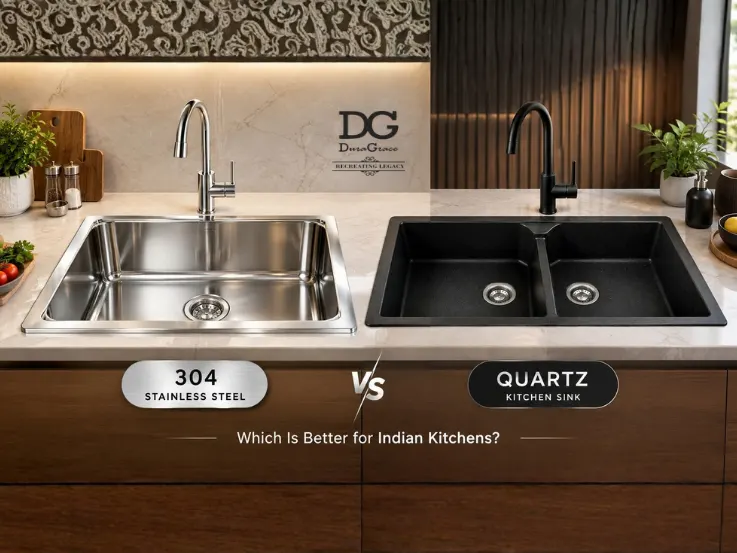
Choose 304 stainless steel if you cook daily, transfer hot pressure cookers and kadais straight from the stove, want the lower upfront cost, or live somewhere your cabinet support isn’t especially strong. Choose quartz if you live in a hard-water city, want a quieter kitchen, cook heavily with turmeric and masala, or want a colour that matches dark modular cabinetry. Both, done well, last 15–20 years. The “better” one depends on how you actually cook and clean — not on which material sounds more premium.
What Is a 304 Stainless Steel Kitchen Sink?
A stainless steel sink is a steel alloy sink with chromium and nickel added for corrosion resistance. “304” refers to the specific alloy grade — roughly 18% chromium and 8% nickel, which is why it’s sometimes labelled 18/8. This is the grade that matters for a kitchen sink, because chromium forms a passive oxide layer on the surface that resists rust and corrosion, and nickel adds toughness and shine retention over years of scrubbing.
304 vs 202 — The Grade That Actually Matters
This is where most buyers get misled, and it’s the single biggest gap in existing buying guides. SS304 and SS202 look identical on a showroom floor. The difference shows up only after 1–2 years of use.
- 304 grade has higher nickel content, which is what actually resists rust and pitting long-term, including under humid Indian kitchen conditions.
- 202 grade substitutes some nickel with manganese to cut cost. It looks the same on day one but is more prone to rust spots and discolouration over time, especially near the drain and in areas with hard or chlorinated water.
If a listing just says “stainless steel” without stating the grade, assume it’s not 304 — legitimate 304 sinks are marked as such because it’s a selling point, not an afterthought.
Gauge Explained: 16, 18, 20 — What the Numbers Mean
Grade tells you what the steel resists chemically. Gauge tells you how thick the sheet is, and that’s what determines dent resistance and the muted “thud” versus tinny “clang” sound when you drop a steel katori in it. Gauge numbers work in reverse — lower number, thicker steel:
| Gauge | Thickness | Best for |
|---|---|---|
| 16 gauge | ~1.5mm | Heavy daily use, commercial-style kitchens, joint families |
| 18 gauge | ~1.2mm | Most Indian home kitchens — the practical default |
| 20–22 gauge | ~0.8–1mm | Budget installs, lighter use — dents more easily over time |
Two “304 sinks” at very different prices are often the same grade at different gauges. Always ask for the gauge, not just the grade, before comparing prices across brands.
What Is a Quartz Kitchen Sink, Really?
Despite the name, a quartz sink isn’t solid stone. It’s a manufactured composite — crushed natural quartz mixed with acrylic or polyester resin and moulded under pressure into a dense, non-porous slab. This is why quartz sinks come in colours (black, grey, beige, white) that plain steel never can, and why the surface feels warmer and more matte to the touch than steel.
The Quartz-to-Resin Ratio and Why It Matters
Quality varies more in quartz than in steel, and this is rarely explained clearly. Reputable manufacturers typically use a composite in the range of 70–80% crushed quartz to 20–30% resin. Higher quartz content generally means a harder, more scratch- and heat-resistant surface; cheaper sinks cut the quartz percentage to reduce cost, which shows up later as a surface that scratches more easily and dulls faster. As a manufacturer, this is the single question worth asking any quartz sink seller directly — a genuine answer is a good sign; a vague one is a warning sign.
304 Stainless Steel vs Quartz: Head-to-Head
| Factor | 304 Stainless Steel | Quartz Composite |
|---|---|---|
| Heat resistance | Excellent — direct contact with hot vessels is fine | Good up to ~280°C, but sudden thermal shock (very hot pan on a cold, wet surface) can cause hairline fractures over time |
| Scratch resistance | Shows fine scratches over years, especially with steel wool | Higher surface hardness (~7 Mohs vs ~5.5 for steel); resists visible scratching well |
| Stain resistance | Good, but can discolour in recesses from strong turmeric/masala if not cleaned promptly | Excellent — non-porous surface, spills wipe off cleanly |
| Noise | Louder — even with sound-dampening pads, dropping steel utensils rings out | Naturally quieter — dense composite absorbs impact sound |
| Weight | Lighter, easier for one or two people to install | 2–3x heavier — some cabinets need reinforced support before installation |
| Hard water | Can show mineral spotting that needs regular wiping | Handles hard water better; non-porous surface hides deposits more effectively |
| Colour options | Silver only | Black, grey, beige, white |
| Typical lifespan | 15–20+ years with basic care | 15–20 years with basic care, more sensitive to harsh chemicals |
Durability & Heat Resistance
For Indian cooking habits — frequent hot-vessel transfers, pressure cookers straight off the gas — steel is the safer material. It handles direct heat with zero risk. Quartz tolerates sustained heat well but the risk isn’t the heat itself, it’s the shock of extreme temperature change on a wet surface. If your routine involves regularly dunking a just-off-the-stove kadai into a sink full of cold water, steel is the lower-risk choice.
Scratch & Stain Resistance
This is a genuine trade-off, not a clean win for either side. Quartz resists visible scratching better because it’s physically harder, but steel resists staining chemically better because it’s non-reactive — the two failure modes are different. If your cutting board occasionally slips into the sink, quartz shows it less. If turmeric-heavy dals sit in the sink for hours regularly, steel handles that better as long as it’s rinsed within a reasonable time.
Noise Level
Quartz wins outright here. This matters more than most buyers expect if your kitchen is open-plan or adjacent to a living/dining area — the difference between a dull thud and a sharp steel clang is noticeable at 9pm when someone’s still doing dishes.
Weight & Cabinet Support
This is one of the most overlooked factors in every existing buying guide. A quartz sink can weigh significantly more than an equivalent steel sink — commonly in the range of 15–25kg depending on size, versus a fraction of that for steel. If you’re retrofitting into an existing modular kitchen counter rather than building new, ask your fabricator to confirm the cabinet and counter support can take the additional load before you commit to quartz. This is a real installation cost that rarely gets mentioned upfront.
Hard Water Performance
If you’re in a city with known hard water — Delhi, Jaipur, Ahmedabad, Hyderabad, and similar — quartz’s non-porous surface handles mineral deposits more gracefully than steel, which can show visible white spotting that needs more frequent wiping to keep looking clean. This isn’t a durability issue for steel, just a cosmetic maintenance one.
Installation & Mounting
Both materials support undermount and top-mount (drop-in) installation. Steel is generally easier and faster to install because of its lower weight and more standardised cutout sizes. Quartz installation benefits from an experienced fabricator, particularly for undermount setups where the counter edge needs to be finished cleanly against the heavier material.
Maintenance & Cleaning
Steel: wipe with mild detergent; avoid steel wool or harsh abrasive scrubbers on brushed finishes, since they can dull the surface over time and ironically make future scratches more visible.
Quartz: avoid acidic cleaners, bleach, ammonia-based solutions, and steel scrubbers — all of these can dull or discolour the surface. A soft sponge and mild soap, followed by drying the surface rather than air-drying, keeps quartz looking new for longer and avoids water-spot buildup.
Warranty — And What Voids It
Warranty terms are rarely explained clearly by any seller, which is a genuine gap. In general:
- Most reputable steel and quartz sink warranties cover manufacturing defects in the sink bowl itself — cracks, structural failure, premature corrosion — typically for several years to a decade depending on the brand and grade.
- Accessories (couplings, waste pipes, baskets) usually carry a much shorter warranty window than the sink body — often a year or two.
- What commonly voids a warranty on either material: using the wrong cleaning agents (steel wool on quartz, harsh acids on steel), physical impact damage, and improper installation that wasn’t done or verified by a qualified fabricator.
Always ask for warranty terms in writing before purchase, specifically what’s covered on the bowl versus the fittings.
Price Comparison: 304 SS vs Quartz in India
Exact prices vary by size, gauge, quartz percentage, and brand, but as a general pattern in the Indian market:
- 304 stainless steel sinks are typically the more budget-friendly option at a comparable size, with cost scaling mainly by gauge (thickness) and bowl configuration (single vs double).
- Quartz sinks generally sit at a premium over steel for an equivalent size, with the premium driven by quartz content, colour, and finish quality.
The price gap narrows at the premium end — a thick-gauge, high-nickel 304 sink from a quality manufacturer can cost close to an entry-level quartz sink. Don’t compare on material alone; compare gauge-for-gauge and quartz-percentage-for-quartz-percentage, or you’re comparing two different tiers of product wearing the same material label.
How to Spot a Genuine 304 Sink (And Avoid a Mislabelled One)
This is a real, common problem in the Indian market, and it’s worth a few minutes before you buy:
- Ask for the gauge and grade in writing, not just verbally at the counter. A legitimate 304 sink from a real manufacturer will state both on the product spec sheet or box.
- Magnet test (rough indicator only): 304 grade is largely non-magnetic or only weakly magnetic; 202 and lower grades tend to be more strongly magnetic due to their composition. This isn’t foolproof on its own, but it’s a useful sanity check alongside documentation.
- Check the finish consistency. Genuine 304 sheet has a uniform brushed or matte finish; cheaper blends sometimes show slight colour or texture inconsistency, especially near welds.
- Buy from a manufacturer or authorised dealer who’ll put the grade on the invoice. If a seller is vague about grade or gauge, that vagueness is itself the answer.
The 5-Question Decision Framework
Answer these honestly and the “which is better” question mostly answers itself:
- Do you regularly place very hot vessels straight into the sink? → Yes leans steel.
- Is your kitchen open to a living/dining space where noise matters? → Yes leans quartz.
- Do you live in a known hard-water area? → Yes leans quartz.
- Are you retrofitting into an existing cabinet, or building new? → Existing cabinet with uncertain load capacity leans steel (lighter, no reinforcement needed).
- Is upfront budget the deciding factor, or is long-term colour/design matching to dark cabinetry the priority? → Budget leans steel; design-matching leans quartz.
Three or more “steel” answers → go 304 stainless steel, 18-gauge or thicker. Three or more “quartz” answers → go quartz, verified 70%+ quartz content, with cabinet support confirmed beforehand.
Common Buying Mistakes to Avoid
- Comparing “stainless steel” to “quartz” without checking gauge or quartz percentage — you’re not comparing materials, you’re comparing unknown quality tiers.
- Not confirming cabinet support before ordering a quartz sink, then discovering an installation delay or extra carpentry cost.
- Assuming all steel is the same because it’s shiny. 202 and 304 look identical until year two.
- Cleaning quartz with whatever’s under the sink — bleach and acidic cleaners are the most common cause of avoidable quartz discolouration.
- Not getting warranty terms in writing, then finding out later that the fittings and the bowl had different coverage periods.
Final Verdict
If you want one sink to do everything acceptably well, both materials clear that bar. But the right choice for your kitchen comes down to three things: how hot your vessels get before they touch the sink, how loud your kitchen can afford to be, and whether your cabinet was built with a heavier sink in mind. Answer those honestly, check the actual gauge or quartz percentage rather than trusting the material name alone, and get warranty terms in writing — the material matters less than the quality tier within it.
Frequently Asked Questions
Which is better, quartz or stainless steel kitchen sink?
Neither is universally better — steel wins on heat resistance, weight, and cost; quartz wins on noise, hard-water performance, and colour options. The right choice depends on your cooking habits and cabinet setup, not a fixed ranking.
Does a quartz sink scratch easily?
No — quality quartz composite has a higher surface hardness than steel and resists visible scratching well, provided you avoid abrasive scrubbers and check the quartz percentage before buying.
Can I put hot vessels directly in a quartz sink?
Quartz handles sustained heat well, but avoid placing a very hot pan directly on a cold, wet quartz surface, since the sudden temperature change can cause hairline fractures over time.
Is a 304 stainless steel sink better than a 202 sink?
Yes, clearly. 304’s higher nickel content resists rust and pitting far better long-term. 202 looks identical when new but is more prone to corrosion within 1–2 years.
Which sink is more affordable in India?
304 stainless steel is generally the more budget-friendly option at a comparable size and gauge, though a premium high-gauge steel sink can cost close to an entry-level quartz one.
Do quartz sinks crack over time?
Quality quartz sinks are durable, but they can develop hairline fractures from repeated thermal shock or a hard direct impact. This is uncommon with normal use and proper care.
Which sink is best for hard water areas?
Quartz generally performs better in hard-water cities because its non-porous surface hides mineral deposits more effectively than steel, which can show visible spotting.
How do I know if my steel sink is genuine 304 grade?
Ask for written documentation of grade and gauge from the seller, check finish consistency, and use a magnet test as a rough (not definitive) indicator — 304 is largely non-magnetic.
Which sink is quieter?
Quartz, by a clear margin. Its dense composite structure naturally absorbs impact sound better than steel, even with sound-dampening pads fitted underneath a steel sink.
Do quartz sinks need special cabinet support?
Often yes. Quartz sinks are significantly heavier than steel — confirm with your fabricator that your existing cabinet and counter can support the added weight before ordering.
Which sink lasts longer?
Both can last 15–20 years or more with proper care. Longevity depends more on grade/quartz-quality and how the sink is cleaned than on which material you pick.
Can I install a quartz sink myself?
It’s possible but not advisable without experience, particularly for undermount installation — the weight and finishing work benefit from a fabricator who’s handled quartz before.