
Currently Empty: ₹0.00
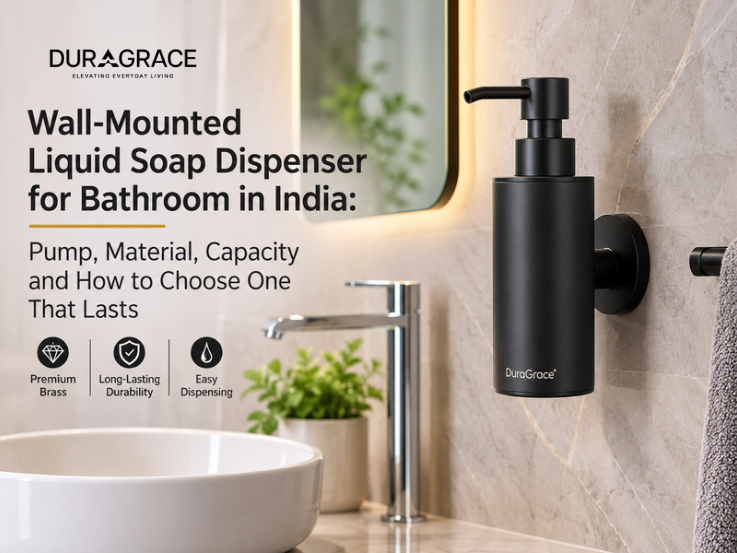
A wall-mounted soap dispenser is one of the smallest purchases in a bathroom and one of the most used. It is pressed several times a day, by wet hands, for years. When it fails, it rarely cracks. It jams, drips or leaves a sticky ring on the basin, and then it is replaced even though the body is fine.
This guide explains what is inside a liquid soap dispenser, why the pump decides how long it lasts, which materials and reservoirs suit a humid Indian bathroom, how much capacity you need, how to refill without contaminating the soap, and where to mount it. It also covers hotels and offices, and what DuraGrace’s wall-mounted range actually lists.
Quick answer: how do you choose a wall-mounted liquid soap dispenser?
Choose a wall-mounted dispenser by its pump and reservoir, not its shine. Look for a brass or SS 304 body, a pump that unscrews and can be replaced, a refill opening you can reach, and a finish named by process. Mount it with the nozzle over the basin, and wash and dry it before every refill.
Wall-mounted soap dispenser at a glance
Part | What to check | Common failure |
|---|---|---|
Body | Solid brass or SS 304, even finish | Thin plating that flakes, rust at screw points |
Reservoir | Glass or metal, easy to reach for refilling | Cracked glass, a narrow opening that spills |
Pump | Replaceable, standard thread, stainless spring | Jams from dried soap or scale; fused to the body |
Nozzle | Sits over the basin, drips cleanly | Drips onto the counter and leaves a sticky ring |
Fixing | Screw-fixed bracket on a plugged wall | Adhesive mounts failing under the weight of a full reservoir |
Finish | Chrome, matte black, gold or rose gold, process named | Wear at the pump head and edges, water spots |
General guidance, not specific to one brand. Check the exact model you are buying.
How does a wall-mounted soap dispenser work, and what is inside?
A manual dispenser pump has a plunger, a spring, two one-way valves and a dip tube. Pressing the head pushes soap out through the nozzle; releasing it lets the spring lift the plunger and draws fresh soap up the tube. Because it has moving parts, the pump, not the body, is usually what wears out first.
The mechanism is the same in a brass wall unit and a supermarket pump bottle. Press the head and the plunger forces soap past one valve and out of the nozzle. Release it and the spring pushes the plunger back up, which creates a small vacuum that draws soap up the dip tube past the second valve. Every press moves soap through a narrow tube, past valves and over a spring, which is why soap that dries, scale that forms or a spring that corrodes can stop the whole thing.
The body, whether brass, steel or glass, does not move. It holds the soap and carries the finish. So when you compare dispensers, compare the pump and the reservoir first and the shine second.
What makes a soap dispenser pump jam or leak?
Pumps jam when thick soap dries in the tube, when hard-water scale builds up in the valves, or when the spring corrodes. Flush the pump with clean water at every refill, dilute very thick soap, and soak a sticking pump in warm soapy water. If the pump is fused to the body, a jam means replacing the whole dispenser.
What you notice | Likely cause | What to do |
|---|---|---|
Pump sticks or will not spring back | Dried soap in the tube, or scale | Soak the pump in warm soapy water; flush with clean water |
Pump presses but no soap comes out | Air in the tube, or a blocked dip tube | Prime with a few presses; clear the tube |
Soap drips from the nozzle after pressing | Worn valve or very thin soap | Replace the pump; use slightly thicker soap |
Soap leaks at the base of the pump | Loose collar or worn seal | Re-seat the pump; replace the seal if there is one |
Pump rusts or squeaks | Corroded spring or low-grade metal | Replace the pump; choose a stainless spring next time |
Pump cannot be removed | Pump fused to the body | Replace the dispenser; check this before buying |
One technical guide from a European maker puts the cause plainly: the pump fails more often than the body, and thick soap that dries in the tube between uses is the most common reason (Aéraly on choosing a dispenser). The practical advice follows from that. Check that the pump unscrews and can be replaced, flush it with about ten presses of clean water at every refill, and keep thick, glycerin-rich soaps diluted if the pump starts to stick.
The same guide notes that the tube and spring inside a good brass body are often plastic and ordinary steel, and that is where corrosion starts. A pump with a stainless steel spring lasts noticeably longer, but sellers rarely say so, so it is worth asking.
Which material is best: brass, SS 304, glass or plastic?
Solid brass and SS 304 are the safest bodies for a humid Indian bathroom, with glass or metal reservoirs. Plastic is cheaper but cracks and wears sooner, and low-grade plated steel can flake and stain. Ask for the base metal and finish process in writing, because photos cannot show either.
Material | Good for | Watch out for |
|---|---|---|
Solid brass | Humid bathrooms, matching accessory sets; heavy and rigid | Thin plating that wears at the pump head |
SS 304 | Coastal and hard-water homes; no plating to flake | Scratches from abrasive pads; look for the grade, not just “stainless” |
Glass reservoir | Seeing the soap level; neutral with every soap | Breakage; water marks |
Metal reservoir | Rough or shared use | Opaque, so no level check |
ABS or plastic | Low budgets, temporary use | Cracks, plating peels, pumps wear faster |
Low-grade plated steel | Rarely worth it | Flakes at weld points, rust stains |
Some sellers quote lifespans such as one to two years for plastic and ten or more for brass. None of the guides we reviewed shows test data, so treat those figures as marketing and judge on construction instead. A heavy brass body, a replaceable pump and an even finish are all things you can check before you buy. Brass weighs noticeably more than zinc alloy at the same size, so weight on the listing is a useful hint.
For how to ask for SS 304 in writing, see our guide to SS 304 vs SS 202. For why the coating on a black dispenser matters as much as the metal, see our guide to matte black bath accessories.
Glass or metal reservoir: which is better?
A glass reservoir lets you see the soap level and does not react with soap, but it can break and shows water marks. A metal reservoir is tougher but opaque, so you check the level by lifting the pump. Choose glass for visibility in a family bathroom and metal for rough or shared use.
The choice is a trade between visibility and toughness. Glass shows when the soap is running low and has a clean look beside a chrome holder, such as DuraGrace’s Lily Chrome dispenser, which pairs a chrome-plated metal holder with a glass dispenser. A metal container, as on the Jasmine dispenser, survives knocks better and suits a washroom where several people use it, but you cannot see the level.
How much capacity do you need?
A home bathroom suits a reservoir of about 300 to 500 ml. If each wash uses about 2 ml and four people wash six times a day, that is roughly 48 ml daily, so 400 ml lasts about eight days. Hotels and offices need larger reservoirs or faster refills. Ask for the capacity in millilitres.
The figures above are an illustration, not a measured average. Pumps deliver different amounts per press, and people press once or twice. Use your own habit: count the presses for a week and multiply. Guides for shared washrooms suggest 500 ml at the low end and 1000 ml or more for high-traffic use, so a hotel or office should size the reservoir to the refill schedule, not the other way round.
Capacity is also a hygiene question. A small reservoir that you empty and wash is easier to keep clean than a huge one that is topped up for months, which the next section explains.
How do you refill a soap dispenser hygienically?
Empty the dispenser before refilling, wash it with warm soapy water, rinse and dry it, then refill and flush the pump. Never top off a half-empty dispenser: CDC hand-hygiene guidance for health-care settings warns that topping off can contaminate the soap. Use one soap at a time, and never mix brands.
Here is what the evidence says, and what it does not. The CDC’s guideline for hand hygiene in health-care settings advises against adding soap to a partially empty dispenser, because “topping off” can lead to bacterial contamination of the soap. A 2011 study in Applied and Environmental Microbiology reports earlier work finding that about one in four refillable dispensers in public restrooms were contaminated, and found that all 14 refillable dispensers in one school were contaminated, while dispensers with sealed refills were not (Zapka et al., 2011). The researchers also note they could not trace actual illness to contaminated soap.
That is a public-restroom and school finding, so the risk in a single family’s bathroom is likely lower. But the fix costs nothing, so it is worth following at home:
- Use up the soap, or pour what is left into a clean container.
- Wash the reservoir and pump parts in warm soapy water, and rinse.
- Let everything dry fully. Leftover water dilutes soap and encourages build-up.
- Refill with one soap only. Do not blend brands or top up a different product.
- Press the pump about ten times with clean water first if it has been standing, then with soap until it flows.
- Wash and dry the dispenser each time you refill, not only when it looks dirty.
For hotels, offices and other shared washrooms, the same research favours sealed refills, where a new bag or cartridge goes in, over open bulk refilling.
Where and how high should you mount it?
Mount the dispenser so the nozzle sits over the basin, about 100 to 110 cm above the floor or 20 to 25 cm above the basin edge. Keep it 10 to 15 cm from the basin edge on your dominant-hand side, with at least 20 cm clear below the pump. Drips then fall into the basin and rinse away.
The nozzle position matters more than the exact number. If the dispenser sits too far from the basin, each press drops a bead of soap on the counter, and within weeks a sticky ring forms. Published guides quote different heights, from about 15 to 30 cm above the basin edge, because basins and users differ. Use the nozzle test: with the dispenser held in position, a drip should fall inside the basin, and your hand should fit comfortably beneath the pump.
- Side: your dominant-hand side, so you do not reach across the basin.
- Clearance: at least 20 cm below the pump, or a hand will not fit.
- Behind the wall: check for pipes or conduit before you drill, especially near a basin or mirror light.
- Fixing: screw-fix with wall plugs. A full reservoir is heavy, and adhesive suits only very light units on perfectly smooth tile.
- Layout: plan it with the tap, mirror and vanity, as in our guide to small Indian bathroom vanity ideas.
Our small-bathroom accessories guide lists the heights of the other accessories and the steps for drilling tile without cracking it, so there is no need to repeat them here. Fix the positions before the tiling is finished if you are renovating.
Wall-mounted or table-top: which suits your bathroom?
Choose wall-mounted to clear the counter and keep drips off it, and choose table-top where you cannot drill or want to move the unit. Wall units fix at a set height and need drilled holes. Table-top units take a permanent spot beside the tap and can leave a sticky ring where soap and limescale collect.
| Wall-mounted | Table-top |
|---|---|---|
Counter space | None used | A permanent footprint |
Installation | Drilled and screw-fixed | None |
Drips | Fall into the basin if placed well | Can leave a ring around the base |
Moving it | Fixed once installed | Easy to move |
Best for | Compact bathrooms, renovations, hotels | Rentals, no-drill walls, powder rooms with a deep counter |
DuraGrace lists both. The Square and Round dispensers sit in its table-top range, such as the Square table-top chrome dispenser, while Glitzz, Flute, Jasmine, Rose and Lily are listed as wall-mounted.
How do you match the finish with your taps and other accessories?
Match the finish to your taps, not your furniture: chrome with chrome, matte black with matte black. Ask how the colour is applied, because PVD coatings and painted or powder-coated finishes wear very differently. Dark finishes show water spots and fingerprints more than chrome, so plan to wipe the dispenser dry.
The pump head is the most-touched part of any accessory, so the finish wears there first. Chrome-plated brass is the most forgiving, because it hides spots and is easy to wipe. Matte black, gold and rose gold look striking but need more wiping, and the coating method matters, which our matte black guide explains. Choose one finish, or two at most, across the metal accessories on a wall, and pick a dispenser from the same series as your towel rail, soap dish and hooks if you want a matched set.
How do you clean and maintain a soap dispenser?
At every refill, run clean water through the pump for ten presses, and wipe the body dry monthly. Every two or three months, empty the dispenser, soak the pump in warm soapy water and descale hard-water deposits gently. Avoid abrasive pads and bleach, which wear brass and coated finishes.
- At every refill: wash, rinse and dry the reservoir, then flush the pump with clean water.
- Monthly: wipe the body dry with a soft cloth and clean around the nozzle, where soap crusts.
- Every two or three months: empty the dispenser, soak the pump in warm soapy water, and rinse. In hard water, descale the nozzle gently with diluted white vinegar and rinse well.
- Never: use steel wool or strong acid or bleach cleaners on a coated finish, or mix cleaning chemicals.
A pump that is starting to stick can be rescued. A fully jammed one often cannot, so act at the first sign of sluggishness.
What should hotels, offices and other shared washrooms check?
Hotels and offices should choose a matching finish across all washrooms, a larger reservoir, spare pumps and a fixed refill routine. Sealed refills reduce contamination risk in shared washrooms, while open refillable units need strict emptying and washing. Ask for spare pumps and repeat-order finish consistency before a bulk purchase.
Shared washrooms add three problems a home does not have. The first is volume: a reservoir that suits a family empties quickly in an office. The second is hygiene, because the topping-off risk in the research above comes from shared settings. The third is consistency, because a hotel that replaces dispensers over several years needs the same finish and the same fit. Ask a supplier whether the same model and finish will be available later, whether spare pumps are sold separately, and whether the product is stated as suitable for hotels, offices or washrooms. DuraGrace’s listings state their dispensers suit homes, hotels, offices and restaurants; for a bulk order, ask about quantities and finishes directly through the contact page.
What do DuraGrace wall-mounted soap dispensers cost?
DuraGrace lists wall-mounted brass dispensers from ₹1,394 (Lily Chrome with a glass dispenser) to ₹2,163 (Jasmine with a metal container), as of November 2026. The pages give size and weight but not capacity in millilitres, so check that before ordering for a busy bathroom. Compare pump, reservoir and finish, not only price.
Dispenser | What the listing says | Listed size and weight | Listed price |
|---|---|---|---|
Chrome-plated metal holder with a glass dispenser, wall-mounted | 14×14×7, 0.39 kg | ₹1,394 | |
Solid brass, matt black finish, wall-mounted | 16×16×7, 0.45 kg | ₹1,781 | |
Solid brass, rose-inspired design, wall-mounted | 19×18×10, 0.5 kg | ₹1,840 | |
Brass with a metal soap container, wall-mounted | 22×10×6, 0.61 kg | ₹2,163 |
Sizes are length × width × height as listed on the product pages. Prices as listed on duragrace.co.in in November 2026, including the site’s current discount. They change, so check the product page.
The Flute range also includes a black brass dispenser in a matt black finish. The listings describe a smooth pump, a rust-resistant brass body and easy refilling, and all of the wall-mounted models suit bathrooms and kitchens. Because capacity is not listed, ask the team before you order for a heavily used bathroom, and use the weight as a rough guide to build quality when comparing brass with lighter alternatives.
Final verdict
A soap dispenser lasts as long as its pump, so choose for the pump first: replaceable, with a stainless spring, on a solid brass or SS 304 body. Pick glass for visibility or metal for toughness, match the finish to your taps, and mount it with the nozzle over the basin so every drip lands where it should. Wash, dry and refill it fully each time, and it will work as smoothly in year five as in week one.
Ready to compare? Browse DuraGrace’s bath accessories, see a finish in person at a DuraGrace store, or contact DuraGrace to ask about specifications before you order.
Frequently Asked Questions
Where should I mount a wall liquid soap dispenser?
Place it beside the basin so the nozzle sits over it, about 100 to 110 cm above the floor or 20 to 25 cm above the basin edge. Keep it 10 to 15 cm from the edge on your dominant-hand side, with at least 20 cm free below the pump, so drips fall into the basin.
What is the best material for a bathroom soap dispenser?
Solid brass or SS 304 suits humid Indian bathrooms best, with a glass or metal reservoir. Plastic costs less but cracks and wears sooner. Avoid low-grade plated steel, which flakes at the edges and stains. Ask for the base metal and finish method in writing, since photos cannot show either.
Why does my soap dispenser pump get stuck?
Thick soap dries inside the tube between uses, and hard-water scale or a corroded spring can add to it. Flush the pump with ten presses of clean water at every refill, dilute very thick soap, and soak a sticking pump in warm soapy water. A pump fused to the body usually means replacing the unit.
How much soap does a bathroom dispenser hold?
Home dispensers commonly hold about 300 to 500 ml, enough for a week or more for a small family. High-traffic washrooms use 500 to 1000 ml or larger systems. Check the stated capacity in millilitres, because listings often give only size and weight, and plan your refill routine to match.
Is it safe to top up a half-empty soap dispenser?
It is better not to. CDC hand-hygiene guidance for health-care settings advises against adding soap to a partly empty dispenser because it can contaminate the soap. Empty it, wash and dry it, refill it fully and flush the pump. The risk is higher in shared washrooms, but the habit is cheap.
Can I use any liquid soap in a wall-mounted dispenser?
Most manual dispensers take ordinary liquid hand wash, but very thick gels can dry in the tube and jam the pump. Thin or diluted soap flows better, and foaming dispensers need foam-grade soap. Avoid soaps with beads or scrubbing particles, and do not mix brands in the same reservoir.
Is a glass or metal soap dispenser better?
Glass shows the soap level and does not react with soap, but it can break and shows water marks. Metal is tougher but opaque. For a quiet family bathroom, glass in a brass or chrome holder looks good; for shared or rough use, a metal reservoir is more forgiving.
Does a wall-mounted soap dispenser need drilling?
Most brass and steel units are screw-fixed, which is the most secure option for a filled reservoir. Adhesive mounts suit only very light plastic units on perfectly smooth tile. Check for pipes behind the wall, drill the tile with a ceramic bit using masking tape, and seal the holes in wet zones.
How do I match a soap dispenser with other bathroom accessories?
Match the finish to your taps and the other metal accessories, such as chrome with chrome and matte black with matte black. Choose one finish, or two at most. For a coordinated set, pick a dispenser from the same series as your towel rail, soap dish and hooks.
How often should I clean a soap dispenser?
Run clean water through the pump for ten presses at every refill and wipe the body dry monthly. Every two or three months, empty it, soak the pump in warm soapy water and descale any hard-water deposits gently. Avoid bleach and abrasive pads, which can wear brass and coated finishes.