
Currently Empty: ₹0.00
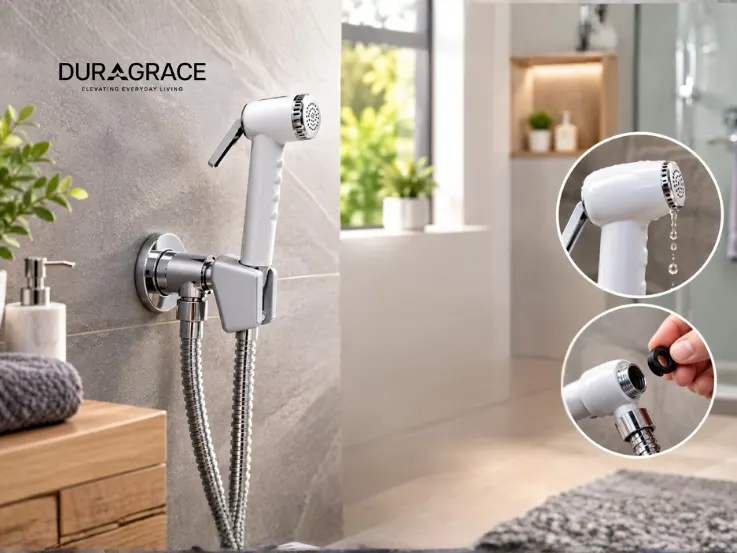
A health faucet is used many times a day, every day, and it is one of the few fittings in an Indian bathroom that you squeeze, drop, pull and re-hang constantly. That is why a cheap one tends to start dripping, lose pressure or crack long before the tiles around it show any wear.
This guide explains what is inside a health faucet, which parts actually decide how long it lasts, how much water pressure it needs, how to pick a hose, how high to mount it, and how to fit and fix it. It also covers the fault finding that most buying guides skip: what a drip at the nozzle, a leak at the handle or a weak jet is telling you.
Quick answer: how do you choose a health faucet?
Choose a health faucet by its inside parts, not its shine. Look for a brass insert or brass body, a stainless steel spring, a braided or SS 304 hose about 1 m long, and a standard ½-inch BSP connection. Fit it on its own angle valve so you can isolate it and adjust the pressure.
Health faucet parts at a glance
Part | What to look for | Common failure |
|---|---|---|
Spray body and insert | Brass body, or chrome-plated ABS with a brass insert; even plating | Cracks near the trigger, peeling plating |
Trigger and spring | Stainless steel spring, trigger that springs back cleanly | Spring fatigue: the trigger sticks or does not return |
Valve seal and O-ring | A replaceable O-ring, spares available | Wear or scale: drips at the nozzle, leak at the handle |
Nozzle | Wide openings that are easy to clean | Scale: weak or split jet |
Hose | Braided stainless steel, about 1 m, metal end nuts | Kinks, cracks at the bend, leaks at the end fitting |
Holder | A sturdy hook that grips the spray | Spray falls, hose sags towards the bowl |
Connection | ½-inch BSP thread (confirm yours) on its own angle valve | Cross-threading, leaks at the wall joint |
General guidance, not specific to one brand. Check the exact model you are buying.
What is a health faucet, and what is inside it?
A health faucet is a hand-held spray with a trigger, connected by a flexible hose to a wall outlet beside the toilet. It is also called a jet spray, bidet spray or toilet gun, and DuraGrace lists it as a commode shower. Inside are a valve, a spring, an O-ring and a hose.
All of these names describe the same fitting. It is not the same as a bathing hand shower, which has a wider spray face and a longer hose and is sold with a shower set (see DuraGrace’s hand showers). The sets in the DuraGrace health faucet range are listed under the commode shower name, so search both terms when you shop.
What is inside the spray
Press the trigger and it pushes a small valve pin off its seat, so water flows to the nozzle. Release it and a spring pushes the pin back, closing the flow. An O-ring seals the moving parts, and the nozzle spreads the water into a jet. That is the entire mechanism, which is why faults trace to a short list of parts: the spring, the O-ring and valve seat, the nozzle (blocked by scale), the hose and the joints.
How much water pressure does a health faucet need?
Pump makers put an ordinary tap at about 1 bar, and the NBC working pressure ceiling is 4.0 bar. Each metre of height between the tank water level and the fitting adds only about 0.1 bar, so a tank 3 m above gives roughly 0.3 bar. Low supply needs a pump; high supply needs a valve.
The tank example is simple physics. A column of water 1 m high presses with about 0.1 bar, so a rooftop tank 3 m above your health faucet gives about 0.3 bar when the water is still. Pipe friction reduces it further while water flows. That is why a health faucet on a gravity supply can feel weak while a pumped supply feels firm.
Your supply | What to expect | What to do |
|---|---|---|
Overhead tank 2–3 m above the fitting | About 0.2–0.3 bar at rest, less when flowing; jet often weak | Check scale and the hose first; consider a booster pump |
Pumped or booster supply | Usually higher and steadier than gravity | Throttle at the angle valve until the jet is firm but comfortable |
Very high supply, near the NBC 4.0 bar ceiling | Strong, wasteful jet; more stress on hose and joints | Pressure-reducing valve or throttle; use a hose rated with margin |
The Indian Plumbing Association’s fixtures material lists 8 litres per minute as the maximum flow for a hand-held bidet spray at 4.0 bar, which is why well-made sprays use a flow restrictor (IPA fixtures chapter). It is training guidance, so NBC 2016 and local rules prevail.
ABS, brass or stainless steel: which health faucet body lasts longer?
Brass bodies generally outlast ABS, but the body is rarely what fails first. Springs, O-rings, threads and hoses do. A chrome-plated ABS body with a brass insert and stainless steel spring can be a sound mid-price choice. Check those internal parts and the hose before paying extra for a metal shell.
Body | Good for | Watch out for |
|---|---|---|
Solid or chrome-plated brass | Main bathrooms and long-term homes | Weight and higher price; plating still needs gentle cleaning |
ABS body with a brass insert | Daily use at a mid price | The quality of the insert and the threads; ask what is actually brass |
All-plastic ABS assembly | Rentals, guest bathrooms, light use | Plating wear, cracks near the trigger, weaker threads |
Stainless steel | Corrosion resistance without plating | Fewer finishes; weight |
Sellers often quote lifespans such as three to five years for ABS and ten or more for brass. None of the guides we reviewed shows test data, so treat those figures as marketing. A better rule: metal threads and a metal insert resist cross-threading and cracking where the hose or valve screws in, and that is where cheap units usually fail. DuraGrace’s own health faucet sets are ABS-bodied, so we say so plainly; the listing for the Zenith adds a brass insert and an SS 304 spring (see the price section below).
Which hose is best: PVC or braided stainless steel?
The hose fails more often than the spray gun. Choose stainless steel braided over plain PVC, ask what the inner tube is made of, and look for brass or stainless end nuts. A 1 m hose suits most bathrooms; use 1.2 to 1.5 m if the commode sits far from the wall outlet.
Plain PVC is cheap, but it kinks at bends and can crack there, and the first leak often appears at the kink.
Braided stainless steel is an outer braid over an inner flexible tube. The inner tube does the sealing and the braid protects it and resists kinking, so ask what the inner tube is made of. The “SS 304” on a listing usually refers to the braid, and the same grade rule applies as for sinks: ask for 304 in writing (see our guide to SS 304 vs SS 202).
End fittings. Leaks usually begin where the hose meets a nut. Brass or stainless nuts hold their threads better than plated plastic.
Pressure rating. Ask the maker for the hose’s rated working pressure. With the NBC ceiling at 4.0 bar, a rating comfortably above it leaves a margin for surges from a booster pump.
Length. One metre suits most compact bathrooms. A hose stretched tight strains its end fittings, so go longer if the outlet is far from the commode, but not so long that it loops on the floor. DuraGrace also lists a braided connection hose in its plumbing range.
Do you need an angle valve for a health faucet?
Connect the hose to its own angle valve or stop valve, not a shared joint. The valve lets you cut off the health faucet to repair it, and turn it partly closed to tame high pressure. Most Indian fittings use a ½-inch BSP thread, but confirm your outlet before buying.
Some kits tap into the cistern supply with a T-connector. It works, but then closing the line to repair the health faucet also shuts the cistern. A dedicated valve avoids that and gives you a pressure control. The IPA material lists an accessible shut-off valve for each toilet among its standard valve locations, which is the same idea.
If your outlet thread does not match, use an adapter fitting rather than forcing the hose nut onto the wrong thread, because forced threads are a common cause of wall-joint leaks.
How high should you mount a health faucet?
Sources differ, but most put the holder about 50 to 70 cm above the finished floor, within easy reach of a seated person and clear of the toilet roll holder. Because bodies differ, mark the position while seated, then check you can reach, pull and re-dock the spray one-handed.
No single height is mandatory. Installer guides and plumbing-height charts quote anything from about 50 to 70 cm for the holder, and some give a separate wall outlet height of about 55 cm. That spread is normal, because people differ in height and so do toilets.
- Sit on the toilet in your normal position.
- Hold a tape or a pencil mark where your hand falls naturally, on the side of your dominant hand.
- Check that you can lift the spray out and put it back with one hand.
- Keep the holder clear of the toilet roll holder, which usually sits at 60–70 cm on the side wall. Our small-bathroom accessories guide covers the other heights and how to drill tile safely.
- Fix the outlet first, so the hose has a gentle curve to the holder and is never stretched.
How do you install a health faucet?
Shut the supply, flush the line, tape the male threads, fit the valve, attach the hose with its washer, fix the holder, then open slowly and test every joint. Tighten by hand plus a quarter turn, because over-tightening cracks plastic and crushes washers. Adjust the valve until the jet is firm.
- Shut off the supply to the bathroom, or to that line if it has its own valve.
- Remove the old fitting and check the thread for damage.
- Open the line briefly to flush out grit before anything is attached.
- Wrap PTFE tape clockwise on the male thread that screws into the valve or outlet, three to four turns.
- Fit the angle valve by hand, then a small turn with a wrench.
- Attach the hose to the valve and to the spray. The hose nut seals on its rubber washer, so check the washer is flat and do not over-tighten.
- Fix the holder at the height you marked.
- Open the supply slowly. Press the trigger, release it, and check every joint for drips with a dry tissue. Then set the valve for a firm but comfortable jet.
A wall-mounted swap with an existing outlet is manageable for a handy homeowner. Concealed installations, or any job that needs new pipework in the wall, need a plumber, because a mistake behind the tile means breaking it. If you would like to see a set in person first, find a DuraGrace store.
Why is my health faucet leaking or losing pressure?
Most health faucet faults come from five causes: scale in the nozzle, a worn O-ring or valve seal, a tired trigger spring, a loose washer at a joint, or a kinked or ageing hose. Match the symptom to the part: drips at the nozzle point to the valve, weak flow to scale or kinks.
What you notice | Likely cause | What to do |
|---|---|---|
Drips from the nozzle after release | Worn valve seal, or scale on the seat | Clean the seat; replace the seal or the spray |
Leak at the handle or trigger | Worn or cracked O-ring, or a cracked body | Replace the O-ring; replace the spray if the body is cracked |
Trigger sticks or does not spring back | Tired spring, or scale in the mechanism | Clean and descale; replace the spray if it persists |
Leak at a hose end | Flat or missing washer, or a loose nut | Re-seat or replace the washer; tighten by hand plus a quarter turn |
Leak at the wall joint | Poor tape, a damaged thread or a worn valve | Refit with fresh tape; replace the valve if it seeps |
Weak or split jet | Scale in the nozzle holes | Descale the spray head |
Weak flow, all taps weak | Low supply pressure | Check the tank height; consider a booster pump |
Hose bulges, cracks or kinks | Ageing or poor-quality hose | Replace it straight away |
If you cannot isolate the supply to the health faucet, that is a sign it needs its own angle valve. A repair that needs the whole bathroom shut off is a repair that gets postponed.
How do you clean and descale a health faucet?
Wipe the body dry after use, descale the spray head every two to three months in hard water, and replace worn washers rather than over-tightening. Soak the head briefly in diluted white vinegar, rinse well, and avoid bleach or harsh acids, which can damage plated finishes.
- Shut the supply and unscrew the spray head or nozzle plate if it comes off, otherwise leave it attached.
- Soak the head briefly in diluted white vinegar, then rub the nozzle holes gently with a soft brush or a toothpick.
- Rinse well with clean water so no acid is left on the plating.
- Check the washers and O-ring. Replace any that are flat, cracked or porous.
- Wipe the body dry. Water spots dry into limescale that dulls the finish.
These are mild steps. In very hard water the head may need descaling sooner; if flow weakens or the jet splits, clean it sooner rather than waiting.
Hygiene and safety: what should you check?
Keep the spray in its holder and never leave the hose end hanging in the bowl. If the line also carries hot water, keep it lukewarm: Indian Plumbing Association material limits bidet mixer water to 38 °C. Wash your hands after use and wipe the holder regularly.
Three practical checks:
- Temperature. If your health faucet is fed from a mixer or a geyser line, test the water on your wrist first. Hot water reaches a sensitive area quickly.
- Backflow. The IPA material lists air gaps and vacuum breakers as backflow protection where a hose end could reach contaminated water. If your layout lets the spray drop into the bowl, ask a plumber whether it needs one.
- The holder. It collects drips and soap film. Wipe it with the rest of the bathroom clean.
What do DuraGrace health faucets cost, and which suits you?
DuraGrace lists three health faucet sets: Aero at ₹369, Hang-On at ₹706 and Zenith at ₹826, as of October 2026. Zenith is the only one whose page lists an SS 304 hose and a brass insert. Compare hose, spring and insert details rather than price alone, and get the warranty in writing.
Set | What the listing says | Listed price | Original price |
|---|---|---|---|
ABS full set with hook and 1 m PVC tube; chrome-plated ABS body | ₹369 | ₹445 | |
ABS full set with hook and tube | ₹706 | ₹850 | |
ABS full set with hook and 1 m SS 304 tube; brass insert, SS 304 spring; in-built filter in selected models | ₹826 | ₹995 |
Prices as listed on duragrace.co.in on 22 October 2026, including the site’s current discount. They change, so check the product page.
In practice: the Zenith’s listing shows the internal parts this guide recommends checking, so it suits a daily-use main bathroom. The Aero, with its PVC tube, is the budget set for light use or a guest bathroom. For the Hang-On, check the tube material before ordering.
Final verdict
A health faucet lasts as long as its weakest part, and that is usually the hose, the spring, the O-ring or the thread, not the shiny shell. Check those, give the fitting its own angle valve, mount it where you can reach it seated, and descale the nozzle every few months. Do that and most leaks and weak jets never start.
Ready to compare? See the Zenith Commode Shower, browse all DuraGrace health faucets or the wider plumbing essentials range, or contact DuraGrace to ask about specifications before you order.
Frequently Asked Questions
What is a health faucet called in India?
In India a health faucet is also called a jet spray, bidet spray, toilet gun, hand bidet or commode shower. They all describe the same hand-held trigger spray, connected by a hose to a wall outlet beside the toilet. DuraGrace lists its sets under the commode shower name, so search both terms.
Is a brass or ABS health faucet better?
Brass generally lasts longer, but the body is rarely the first thing to fail. Springs, O-rings, threads and hoses wear first. A chrome-plated ABS body with a brass insert and a stainless steel spring can be a sound mid-price choice, while an all-plastic internal assembly is best kept for light use.
Why is my health faucet leaking from the handle?
A leak at the handle usually means a worn or cracked O-ring inside the gun, or a cracked body near the trigger. Shut the supply, unscrew the gun, and replace the O-ring if it is flattened or split. If the body itself is cracked, replace the whole spray, because patching rarely holds under pressure.
Why is my health faucet pressure low?
Weak flow is most often scale blocking the nozzle holes or a kinked hose. Soak the head in diluted vinegar, straighten the hose and open the angle valve fully. If other taps are weak too, the cause is low supply, such as a tank only a metre or two above the fitting.
How much water pressure does a health faucet need?
Pump makers put an ordinary tap at about 1 bar, and the NBC working pressure ceiling is 4.0 bar. A gravity tank 2 m above the fitting gives only about 0.2 bar and often feels weak. Fit a booster pump for low supply, and throttle the angle valve or add a pressure-reducing valve for very high supply.
What hose length should I buy?
One metre suits most compact bathrooms. If the commode sits far from the wall outlet, choose 1.2 to 1.5 m so the hose is never stretched taut, which strains the end fittings. Avoid an overly long hose too, because loose loops kink and trail on the floor.
Can I install a health faucet myself?
Yes, for a simple wall-mounted swap with an existing outlet, using an adjustable wrench and PTFE tape. Shut the supply, fit the valve and hose, fix the holder and test for leaks. Call a plumber for concealed installations or new pipework inside the wall, since mistakes there mean breaking tiles.
How high should a health faucet be mounted?
Installer guides vary from about 50 to 70 cm above the finished floor for the holder. Mark the position while seated, check you can reach, pull and re-dock the spray one-handed, and keep it clear of the toilet roll holder. Adjust for the heights of the people who will use it.
How often should I descale a health faucet?
In hard water, descale the spray head every two to three months and wipe the body dry after use. If flow weakens or the jet splits sooner, clean sooner. Soak the head briefly in diluted white vinegar, rinse well, and avoid bleach or harsh acids on plated parts.
Is a braided steel hose better than a PVC hose?
Generally yes. A stainless steel braided hose resists kinking and protects the inner tube, while plain PVC kinks and can crack at the bend. The inner tube still does the sealing, so ask what it is made of and check the end fittings, because that is where leaks usually start.