
Currently Empty: ₹0.00
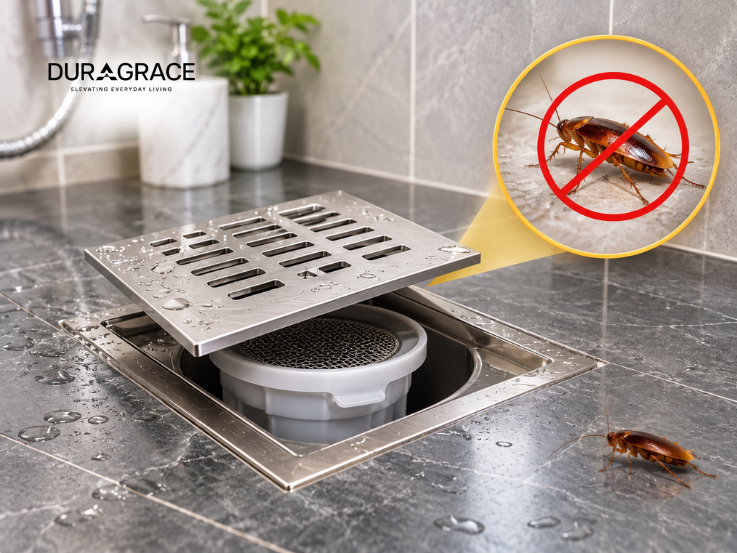
A cockroach in the bathroom at midnight, or a sour smell when you come back from a holiday, usually sends people shopping for a new drain cover. Often the cover is not the problem. The barrier that matters sits underneath it, in a small pocket of water that has quietly dried out.
This guide explains how a bathroom floor drain keeps pests and smells out, how the common anti-cockroach inserts (cup, flap and diaphragm) really work, how deep the water seal should be, why even good drains fail, and how to choose, fit and maintain one. It also says plainly what no drain can do: a drain is one barrier in a bathroom, not a guarantee.
Quick answer: how do you stop cockroaches and smells coming up a bathroom drain?
Keep a water seal of at least 50 mm in the floor trap, because the water is the main barrier. Add a removable cockroach cup or flap for extra protection, choose rust-proof SS 304 for the cover, seal gaps around pipes, and pour water into unused drains monthly. No drain cover alone can guarantee a pest-free bathroom.
Floor drain parts at a glance
Part | Job | What to check | Common failure |
|---|---|---|---|
Grating (jali) | Lets water in and catches hair | Material and grade, easy to lift | Rust, bent frame, loose fit |
Frame | Holds the grating flush with the tile | Size matches the opening, no gaps | Gaps that let insects in, rocking |
Cockroach cup or flap | Extra barrier against pests | Removable, fits snugly | Removed to speed drainage, jammed by hair or scale |
Floor trap (nahani trap) | Holds the water seal | Seal depth of at least 50 mm, easy to clean | Dry seal, shallow seal, blockage |
Outlet pipe | Carries water to the stack | Correct size, sealed where it passes through the floor | Gaps around the pipe |
Backwater valve | Stops reverse flow | Needed only where flow can reverse | Hair clogging it |
General guidance, not specific to one brand. Check the exact model you are buying.
How do cockroaches and sewer gas get into a bathroom through the drain?
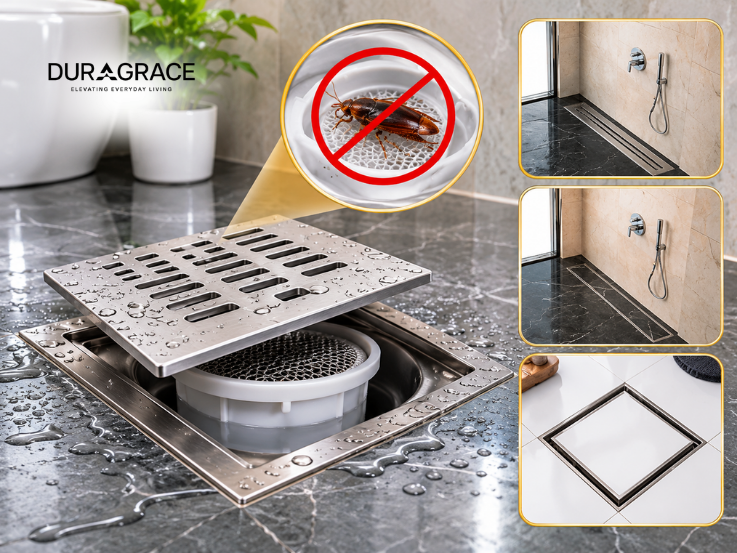
Cockroaches and sewer gas mainly use a drain when the trap’s water seal has dried out, when gaps surround the pipe or frame, or when the drain joins a shared stack. A full seal, a tight frame and sealed pipe gaps close most routes. Cockroaches living inside walls will not be stopped by a drain.
Every bathroom drain connects to the same plumbing network as the rest of the building. In an apartment, that is often a shared vertical stack that serves many floors. Warm, damp pipes carrying hair and soap residue are an attractive place for cockroaches, so the drain is a real route, but it is only one of several.
A dry seal. The commonest route. A floor trap in a guest bathroom, a spare room or a balcony drain that gets no water for weeks loses its seal to evaporation. Studio Matrx’s India guide to bathroom smells names the dry nahani trap as the number-one cause of a sewer smell in a bathroom where nothing is broken (Studio Matrx on sewer gas smells).
Gaps around the frame and pipes. One pest-control guide notes that an adult German cockroach can squeeze through a gap of about 3 mm, and that the space around a drain frame or where a pipe passes through a wall or floor is often larger (Pest Patrol).
The basin overflow. The small overflow hole at the top of a basin connects to the waste pipe without passing through the trap, so it can be a route as well.
Insects already inside. Cockroaches also live in wall voids, behind cabinets and under sinks. A new drain cover does nothing about those. If you see them in daylight or in numbers, the problem is larger than the drain, and a pest professional is the right call.
What comes up with the insects is sewer gas. Studio Matrx describes it as a mix of mostly methane and carbon dioxide, with the rotten-egg smell coming from hydrogen sulphide. In a bathroom the problem is usually smell, but a strong, sudden smell that does not clear with ventilation, especially near a gas geyser, is a reason to ventilate, avoid flames and call a plumber.
What does the water seal do, and how deep should it be?
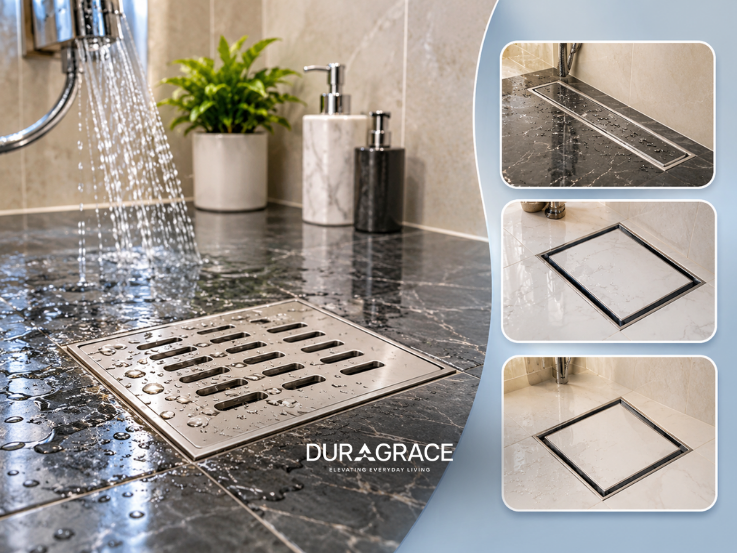
Indian Plumbing Association guidance asks for a floor drain trap with a water seal of at least 50 mm, and shows a typical nahani trap as an example of an inadequate seal. Traps lose their seal by siphonage, back pressure and evaporation. In a rarely used bathroom, evaporation is the usual cause, so keep the seal topped up.
The seal is the plug of water held in the trap. It is the main thing that stops sewer gas and, as far as a barrier can, pests. The IPA traps chapter is code-based training material, so NBC 2016 and local rules prevail, but its points are a useful checklist for a floor drain:
- A liquid seal of not less than 50 mm, and not more than 100 mm for a deep-seal trap.
- A floor drain trap built so it can be cleaned easily, with the drain inlet in full view.
- A backwater valve where the drain is subject to reverse flow.
- A trap seal primer on floor drains that are used infrequently, so the seal is topped up automatically.
- No trap that depends on movable parts for its seal.
That last point matters when you buy an anti-cockroach insert, as the next section explains. The same chapter lists the three ways a trap loses its seal: siphonage (pulled out when pressure drops), back pressure (pushed back) and evaporation. Siphonage and back pressure are venting problems for a plumber. Evaporation is the one you can fix with a jug of water.
How does an anti-cockroach trap work? Cup, flap and diaphragm designs
Anti-cockroach inserts come in three common designs: a water cup inside the drain, a hinged flap that opens under water flow, and a spring or silicone diaphragm valve. The cup relies on water, while flaps and diaphragms rely on moving parts that hair and scale can jam. Treat all three as extras on top of a proper water seal.
Design | How it blocks | Strength | Weakness |
|---|---|---|---|
Water cup | A cup under the grating holds water around its skirt, so there is no dry path from pipe to room | Simple, no moving parts, easy to rinse | Needs water; a dry or removed cup leaves a gap |
Hinged or gravity flap | A plate opens under draining water and drops back when flow stops | Blocks insects when closed | Hair, scale or a bent hinge can hold it open |
Spring or silicone diaphragm | A flexible seal opens under flow and closes afterwards | Compact, shuts firmly | The seal can harden or tear over time |
General descriptions; design names vary by maker.
A typical set has a frame, a grating (jali) and a removable cup or insert beneath it. The grating catches hair and large debris, and the insert adds a physical barrier. Many guides describe flap designs as stopping pests completely. The IPA guidance suggests a more careful reading: a trap whose seal depends on movable parts is not the code-based approach, so a flap is best treated as an extra layer above a water-filled trap, not a replacement for one.
Also be wary of sweeping claims. Some pest-control sources point out that certain cockroaches can survive submerged for a long time, so a water seal slows them rather than guaranteeing exclusion. That is why a layered approach (seal, insert, sealed gaps, clean surroundings) works better than any single fitting.
Why do anti-cockroach drains still fail?
Anti-cockroach drains fail for a few repeat reasons: the water seal has dried out, someone removed the cup to speed drainage, hair has jammed a flap, the frame leaves gaps, or the insects are already inside the walls. Check the seal and fit first, then seal pipe gaps, and call a pest professional for daytime sightings.
What you notice | Likely cause | What to do |
|---|---|---|
Smell in a rarely used bathroom | Dry water seal | Pour one to two litres of water down the drain |
Smell after a long absence | Seal evaporated | Top up; consider a trap seal primer for a drain that keeps drying |
Cockroaches still appear near the drain | Gaps around the frame or pipes, or insects in the walls | Seal gaps with silicone; call a pest professional if you see them by day |
Slow drainage | Hair and soap in the grating or cup | Lift out, clean, rinse and refit |
Cup or flap missing | Removed to speed drainage | Refit it; check the pipe for the real blockage |
Cover rocks or sits above the tile | Wrong size or poor fit | Reset the frame flush with the finished tile |
Smell appears only after another fixture drains | Siphonage from poor venting | Ask a plumber to check the vent |
The fix for the first row is the simplest and most useful habit in this guide: pour water into every unused drain once a month. One pest-control guide and Studio Matrx both also mention a spoonful of cooking oil floated on the seal to slow evaporation over a long absence. Use no more than a teaspoon, and flush the drain with water when you return.
Which material is best: SS 304, SS 316, plastic or PTMT?
SS 304 suits most indoor bathrooms, while SS 316, which resists chlorides better, is the upgrade near the coast or pools. Plastic or PTMT covers cost less but can crack or fade. The trap body below the cover is normally plastic, brass or cast iron, so judge the cover on rust-proofing and the trap on seal depth.
The cover and the trap are different parts with different jobs. The cover sits in daily steam and cleaner splashes, so it needs to resist rust. Stainless steel in grade 304 does this well in a normal bathroom. Grade 316 contains molybdenum, which improves resistance to chlorides, so it is the usual upgrade for coastal homes. Indian makers sell round and square stainless steel covers, and some offer PTMT, a tough plastic, as a lower-cost option.
The trap below the cover is a different matter. IPA guidance lists ABS, cast brass, cast iron, PP and PVC as acceptable trap materials, and asks for a smooth, self-cleansing waterway. So do not expect the trap to be stainless steel; ask instead for its seal depth and how easily it can be cleaned. For how to ask for a stainless grade in writing, see our guide to SS 304 vs SS 202.
Finish matters for looks as well: the DuraGrace tile-insert channels come in chrome, gold, rose gold and black, and our guide to matte black bath accessories shows how to match a black drain with the rest of the bathroom.
How do you choose the right size, shape and fit?
Measure before you buy: the opening in the floor, the cover and frame size, the outlet pipe, the depth below the tile, and the floor slope. Round covers fit existing round openings, while square ones may need tile cutting. A cover that fits on top but not on the trap below will leak or rock.
- Opening. Measure the existing opening in the floor and the frame around it.
- Cover and frame. The frame must sit flush with the finished tile and hold the cover without rocking.
- Outlet pipe. Check the size of the pipe the trap connects to, and how it passes through the floor.
- Depth below the tile. The trap needs space for its seal and for you to lift out the cup. If depth is short, ask for a low-profile design.
- Slope. Water has to run to the drain. A flat floor leaves puddles even with a perfect cover.
- Shape. A square or round point drain suits a floor that slopes to one low point. A long channel suits a defined shower zone with a one-way slope. Our guide to linear vs point drainers helps you choose, and the shower set guide covers the shower zone around it.
In a renovation, take the old fitting’s measurements to the shop and have your plumber check the outlet and floor level before you order. A mismatch discovered after the tile is cut is the most expensive mistake in this category.
How do you install a floor drain with a cockroach trap?
Fit the trap and frame before tiling, set the frame flush with the finished tile, and slope the floor evenly towards the drain. Fill the trap with water, run a bucket test to check flow and leaks, and seal the pipe where it passes through the floor. Confirm the cover lifts out easily for cleaning.
- Fix the trap and its outlet to the waste line at the correct level, before the floor is screeded.
- Seal around the pipe where it passes through the slab, so there is no gap for insects or water.
- Screed the floor to slope evenly towards the drain, then waterproof as your builder specifies.
- Set the frame so it will finish flush with the tile, and tile up to it.
- Fill the trap with water, then pour a bucket through the drain and watch for leaks and flow.
- Fit the cup or insert and the grating, and check that you can lift both out with your fingers.
- Seal any visible gap between the frame and the tile edge with flexible sealant.
Plumbing and waterproofing are plumber and tiler jobs. Do not break into a finished floor to swap a drain without allowing for slope and waterproofing rework.
How do you keep the water seal filled when a bathroom is rarely used?
Lift the cover and clean hair and soap from the cup every month, rinse it, and put it back. Pour a litre or two of water into rarely used drains monthly. Avoid mixing drain chemicals. Never leave the internal cup out, because it forms part of the water seal and the pest barrier.
- Monthly: lift the grating, clean out hair and soap, rinse the cup and refit it.
- Rarely used drains: pour one to two litres of water a month, more often in hot, dry weather.
- Before a long absence: top up the seal, and consider a teaspoon of oil on top for a drain you cannot reach.
- For a drain that keeps drying: a trap seal primer tops up the seal automatically, and the IPA guidance recommends one for floor drains with infrequent use.
- Cleaning chemicals: never mix acid cleaners with bleach, because the fumes are hazardous, and avoid pouring boiling water on plastic traps.
- Hard water: descale the grating as you would a shower head, and wipe the grate weekly.
One caution for pest control: baking soda and vinegar clean a drain, but pest-control sources agree they do not kill cockroaches. If the insects keep coming, cleaning is not enough.
Do you need a backwater or non-return valve?
A backwater or non-return valve stops sewage and pests flowing back up the drain, and the IPA material calls for one where a floor drain is subject to reverse flow. It is mostly relevant on ground floors and low-lying drains. Fit it after the trap, keep it accessible for cleaning, and use a plumber.
A backwater valve is a one-way gate in the waste pipe. On an upper floor of a building with a working vent system it is rarely needed. On a ground floor, a basement, or any drain that can back up when the main line is full, it is worth discussing with your plumber. Two cautions: it should sit after the trap, so normal drainage is not blocked, and it needs cleaning access, because hair and soap collect on its flap.
What if cockroaches keep coming back?
If the water seal is full, the frame is tight and the pipe gaps are sealed, the drain is probably not the source. Cockroaches also live in wall voids and behind fittings, so look for moisture, leaks and food, and seal gaps with silicone. Terminix and Pest Patrol both advise professional help if you see cockroaches in daylight or in numbers, because it usually means an established colony that DIY cleaning will not reach.
Three things help in the meantime. Fix leaks and wipe the bathroom dry after use, because cockroaches need moisture. Do not rely on repellents such as vinegar or essential oils, which at best move the problem elsewhere. And treat the drain as one layer: fill the seal, fit the insert and seal the gaps.
What do DuraGrace drains cost, and how do they fit in?
DuraGrace lists three drainers: tile-insert squares from ₹978, shower channels from ₹2,542 and tile-insert channels from ₹2,797, as of November 2026. The pages describe stainless steel covers and sizes but no built-in trap, so choose the trap and seal depth beneath separately, and ask the seller what the cover sits on.
Product | What the listing says | Sizes (inches) | Finish | Listed price |
|---|---|---|---|---|
Stainless steel, tile-insert cover that takes a matching floor tile | 4×4, 5×5, 6×6 | Chrome | ₹978–₹1,318 | |
Stainless steel channel, concealed tile-insert design | 4×12 up to 5×48 | Chrome, gold, rose gold, black | ₹2,797–₹15,990 | |
Stainless steel shower channel, designs Liner, Qubix and Wave | 4×12 up to 5×48 | Chrome, gold, rose gold, black | ₹2,542–₹13,592 |
Prices as listed on duragrace.co.in in November 2026, including the site’s current discount. They change, so check the product page.
These are cover and channel systems. A tile-insert drain solves the look, because the cover takes a matching floor tile and the drain almost disappears, and it solves cleaning access, because the insert lifts out. The pest and smell barrier is the trap beneath, so choose the trap and its seal depth together with the cover. Browse the tile insert drains and shower drainers to compare sizes and finishes.
Final verdict
A bathroom drain keeps pests and smells out in layers. The water seal does most of the work, so keep it at least 50 mm deep and keep it filled. A removable cup or flap adds a second barrier, sealed gaps remove the shortcuts, and a stainless steel cover that lifts out makes cleaning easy enough that you will actually do it. No fitting can promise a pest-free bathroom, but these layers make the drain the least likely way in.
Ready to compare? See DuraGrace’s drainers, or contact DuraGrace to ask about specifications and compatible traps before you order.