
Currently Empty: ₹0.00
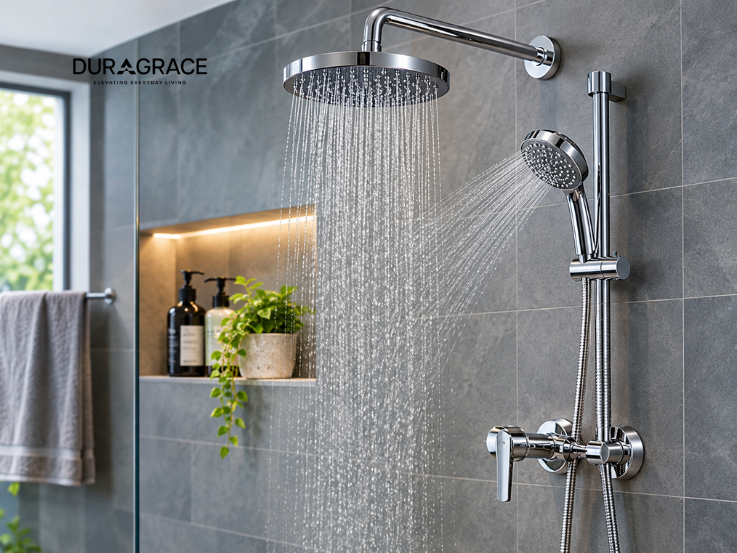
Most shower disappointments are not caused by the shower head. A beautiful 12 inch rain head goes on the wall, the first bath is a warm mist, and the family blames the product. The real cause is usually sitting on the roof: a gravity tank that delivers a fraction of the pressure the head was designed for.
This guide shows how to plan a full shower set the other way round. You start with your own water pressure, then choose the overhead shower, the hand shower and the diverter that link them, so every part works with the others. It covers how to measure your flow with a bucket, which head size suits which pressure, what a diverter can and cannot do, how high to fix everything, how to fix a weak shower, and what to look for in hard water.
Quick answer: how do you plan a full shower set?
Plan the shower set around your water pressure, not the showroom. Measure your flow with a bucket first, then choose an overhead size and hand shower to match, link them with a diverter that switches between outlets, and keep arm, hose and thread sizes compatible. Most Indian homes suit a 6 to 8 inch overhead plus a hand shower.
Shower set at a glance
Part | Its job | What to check |
|---|---|---|
Supply (tank or pump) | Sets pressure and flow | Measured litres per minute, pipe size |
Mixer | Blends hot and cold water | Compatible with the diverter; steady temperature when other taps open |
Diverter | Chooses the outlet | Flow rating, number of outlets, access for servicing |
Shower arm | Carries the overhead head | Thread, length (300–400 mm), metal, wall flange |
Overhead shower | Hands-free spray | Size matched to flow, silicone nozzles, material |
Hand shower and hose | Directed rinsing and bathing | 1.5 m braided hose, ½-inch BSP thread, holder or slide bar |
Isolation valves | Shut off for repairs | One on each hot and cold line, within reach |
General guidance, not specific to one brand. Check the exact model you are buying.
What is a full shower set, and how do the parts connect?
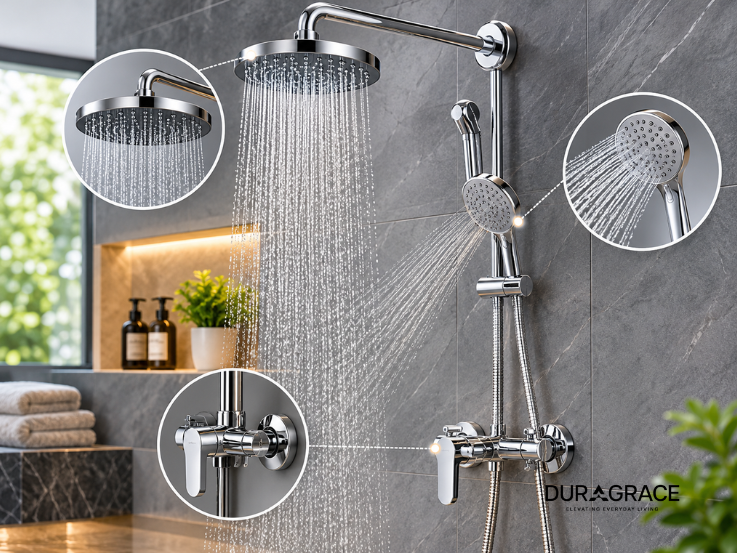
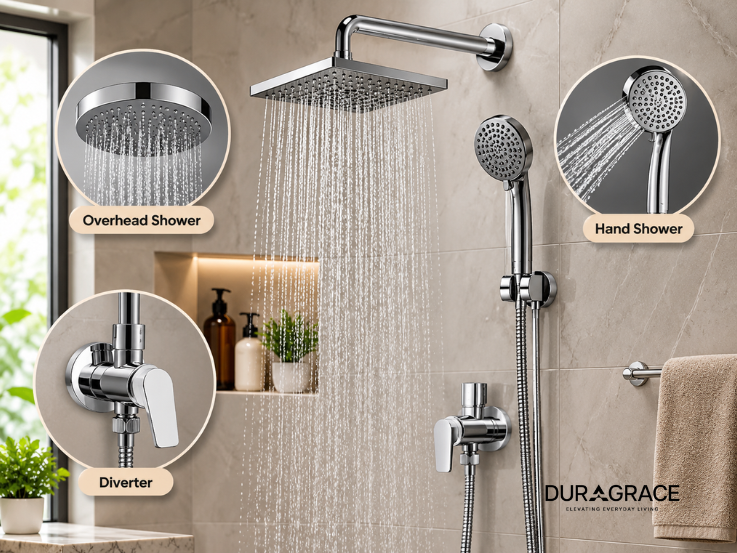
A full shower set runs from the supply through a mixer and diverter, then splits to the overhead shower on a wall arm and the hand shower on a hose. Each part limits the flow reaching the next, so the weakest link sets the experience. Choose parts with compatible threads and similar flow ratings.
Follow the water. It leaves the tank or pump, reaches the mixer where hot and cold blend, passes through the diverter that chooses the outlet, and then travels either up a wall arm to the overhead head or along a hose to the hand shower. Anything narrow in that chain, such as a small supply pipe, a restrictive diverter or a clogged nozzle, holds back everything after it.
That is why “set” means more than “two heads in one box”. DuraGrace sells overhead showers, shower arms, hand showers and full sets, while the mixer and diverter are chosen with your plumber or from your concealed-valve brand. Most Indian hand showers and arms use a ½-inch BSP thread, but confirm each connection before you buy, because a mismatched thread needs an adapter, and every adapter is one more place to leak.
How much water pressure and flow do you need?
Measure first: collect shower water in a bucket for 30 seconds and double the litres to get litres per minute. Under 8 suits a hand shower or small overhead; 8 to 15 suits most overheads; above about 25 is needed for large rain heads. A gravity tank adds only about 0.1 bar per metre of height.
The bucket test comes from Kerovit’s shower pressure guide and needs no equipment. Run the shower into a bucket for 30 seconds, measure the litres and double it. Do it with the shower alone, then again while someone flushes a toilet or runs a tap, because pressure while water is flowing is always lower than pressure at rest.
Measured flow | What it suits | Notes |
|---|---|---|
Under 8 litres a minute | A hand shower or a small overhead (about 4–6 inch) | An aerating head helps; avoid multi-mode hand showers |
8–15 litres a minute | Most overheads (6–10 inch) and a hand shower, one at a time | The usual range for tank-fed homes with a pump |
15–25 litres a minute | A large overhead (10–12 inch), multi-mode hand shower | Needs steady supply |
About 25 and above | Large rain heads and body jets | Published guides say this needs a booster pump |
These are rough bands that published Indian guides share. They do not agree exactly: one design guide says a 150–200 mm head works from about 0.5 bar, while a manufacturer’s guide puts standard 200–250 mm overheads at 1–2 bar and a 300 mm rain head at 3 bar. A range this wide is a reason to trust your own bucket test over any brochure.
What gravity gives you
The physics is simple: 1 metre of water height gives about 0.1 bar. A tank whose water level is 3 m above the shower arm gives about 0.3 bar at rest, and 6 m gives about 0.6 bar. Some guides say each floor of a building costs only about 0.1 bar, but a floor is roughly 3 m high, so the real loss is nearer 0.3 bar. That is why a top-floor flat fed by a rooftop tank can have a weak shower while the same head works well on a pumped supply.
Worked example: a bathroom on the top floor sits only 1.5 m below the tank outlet, so static pressure is about 0.15 bar. The same bathroom on a booster pump may give 1.5 bar or more. A 10 inch rain head would feel very different in the two homes, and only the second is a fair test.
Which overhead shower should you choose: size, shape and material?
For most Indian bathrooms, a 6 to 8 inch overhead shower in SS 304 or chrome-plated ABS is the safest choice. Go to 10 or 12 inches only with a booster pump or strong supply, because a bigger face spreads the same flow thinner. Choose anti-clog silicone nozzles, and match the arm to the head.
Size. Overhead heads are sold by face diameter: 6 inch is about 150 mm, 8 inch about 200 mm, 10 inch about 250 mm and 12 inch about 300 mm. A bigger face needs more flow to look and feel full. On a weak supply, a smaller aerating head will out-perform a large rain head, because the rain head spreads the same litres so thinly that only the centre of the face flows properly.
Material. SS 304 resists rust and keeps its shape in daily steam, which is why it suits a face plate. Chrome-plated ABS is lighter and cheaper and is fine for a modest budget. In both cases check the silicone nozzles: soft rubber cones that you rub with a thumb to crack off scale, which matters more in hard-water India than the finish does. See our guide to SS 304 vs SS 202 for how to ask for the grade in writing.
Wall arm or ceiling. A wall arm is the default, flexible and easy to retrofit. A ceiling-mounted head hangs directly over the standing zone and looks cleaner, but the supply must be run in the ceiling before the false ceiling and tiles go in, so it is a decision for the first stage of the build and hard to reverse.
DuraGrace’s overhead showers include SS 304 Mazz and Nile heads in 6, 8, 10 and 12 inch sizes (Nile in 6, 8 and 12), and ABS heads for lower budgets. Pair them with a metal shower arm so the head is carried by a rigid, corrosion-resistant part.
Which hand shower should you choose, and how is it different from a health faucet?
Pick a hand shower with a braided hose about 1.5 m long, a standard ½-inch BSP connection, and a holder or slide bar at the right height. Single-flow models cope better with low pressure, while multi-mode ones need more. A hand shower is for bathing and cleaning; a health faucet is a separate fitting.
A hand shower gives you what a fixed head cannot: directed water. It is how you rinse the walls and floor, wash a child or an elderly family member who cannot stand under a fixed head, and fill a bucket during a low-pressure hour. It is also the fitting that works on almost any supply.
Pressure. Single-flow hand showers keep working at low pressure. Jet and massage modes depend on force, so a multi-mode model on weak supply will feel the same in every mode. If your flow is low, choose single-flow or an aerating hand shower.
Hose. A braided stainless steel hose resists kinks and is better than plain plastic. A length of about 1.5 m suits most bathrooms; avoid very short hoses, which limit movement.
Holder. A fixed bracket is simplest. A slide bar adjusts from about 70 to 130 cm, so tall and short users can both reach it.
Do not confuse it with the health faucet beside the toilet. The two look similar but sit in different places, work at different pressures and are fitted with their own shut-off valve; our health faucet guide explains the difference. DuraGrace’s ABS hand showers include the Maze Hand Shower Round, and the Brazil and Greece Flair sets.
What does a shower diverter do, and can both showers run at once?
A diverter sends water to one outlet at a time, such as the overhead shower or the hand shower. A standard 2-way diverter does not run both together, and some are built into the mixer. Check the diverter’s flow rating, because a restrictive one can weaken both outlets, and keep it accessible for servicing.
The diverter is the part that makes a two-head set practical. You turn or pull its control and the water moves from the overhead shower to the hand shower. The common versions are:
- 2-way: two outlets, one at a time. The usual choice for an overhead plus a hand shower.
- 3-way and above: three or more outlets, for example an overhead, a hand shower and a spout, or body jets in a larger system.
- Built into the mixer: a diverter mixer combines hot and cold control and outlet selection in one unit.
- Spout diverter: a pull knob on the bath spout that sends water up to the shower, common in older bathrooms.
Two practical points. First, the diverter’s internal bore limits flow, so ask for its rated flow before you buy, especially if your supply is already modest. Second, a thermostatic mixer holds a set temperature even when another tap opens elsewhere, which prevents the sudden cold or hot burst that manual valves cannot prevent.
Put an isolation valve on each hot and cold line to the mixer, within reach, so you can stop the water without closing the whole supply; see our angle valve guide for how many you need and where.
How do you fix low shower pressure?
Fix low pressure in order of cost: clean scale from the nozzles, remove any restrictor insert, fit an aerating head, check for narrow supply pipes, then add a booster pump. A pump is the only fix that raises pressure itself, and it is essential before a large rain head or body jets.
- Clean the nozzles. Rub silicone nozzles and soak the head to clear scale. This costs nothing and is often the whole problem.
- Check for a flow restrictor. Some heads have a small insert fitted for high-pressure supplies. Removing it increases flow, but check the warranty first, because some makers treat it as a modification.
- Fit an aerating head. Aeration mixes air into the water so the spray feels fuller on the same flow. It does not change the pressure, only how it feels, and the saving depends on the head, so ask for its rated flow.
- Check the pipework. Narrow supply pipes, especially older ½-inch lines, and scale inside pipes reduce flow. A larger branch line to the shower can help.
- Add a booster pump. On a weak gravity supply it is the real fix, and often costs less than the designer head it rescues. One Indian design guide lists pumps at roughly ₹6,000 to ₹20,000.
If pressure is weak everywhere in the house, no shower fitting will fix it. If it is weak only at the shower, work down the list.
How high should you mount the overhead and hand shower?
One Indian design guide puts a wall-arm head at about 2000 to 2100 mm above the finished floor, the arm projecting 300 to 400 mm, and the control valve at 1000 to 1200 mm. Slide bars typically adjust from about 70 to 130 cm. Fix heights to your tallest user before tiling.
Element | Typical range | Note |
|---|---|---|
Wall-arm head height | 2000–2100 mm above finished floor | Clears a tall adult’s head |
Ceiling head height | 2100–2200 mm | A vertical fall needs a little more clearance |
Arm projection | 300–400 mm | Puts the spray over the standing zone, not the wall |
Control valve or diverter | 1000–1200 mm | Reachable without stepping into the spray |
Hand shower slide bar | About 70–130 cm adjustment | Suits tall and short users alike |
The head and arm figures come from the Studio Matrx overhead shower guide, and installers vary, so treat them as a starting point and confirm on site. In a family with very different heights, a wall arm works better than a fixed ceiling head, because a shorter person can stand a step back and still be under the spray. For the heights of the other fittings in the bathroom, see our small-bathroom accessories guide, and plan the floor slope and drain together with the shower zone, as covered in our guide to linear vs point drainers.
How do you install a full shower set?
Fit concealed parts such as the mixer and diverter before tiling, flush the lines to clear grit, then fit the arm with PTFE tape and a quarter turn past hand-tight. Attach the head and hose last, switch each outlet on, and check for leaks and flow at both hot and cold settings.
- Decide heights and positions with your tallest user, and mark them on the wall.
- Fit the concealed mixer and diverter and its pipework before tiling, and pressure-test the lines.
- Close the supply, then open the line briefly to flush out grit before any head is attached, because grit is what blocks fine nozzles.
- Wrap PTFE tape three or four turns clockwise on the arm’s male thread and screw it in by hand, then a final quarter turn. Seat the wall flange flat.
- Fit the overhead head onto the arm with its washer, tightening by hand.
- Connect the hose to the wall outlet and to the hand shower, with a washer at each end, and fix the holder or slide bar at the marked height.
- Open the supply slowly. Run each outlet and check every joint with a dry tissue.
- Test hot and cold at the mixer and confirm the diverter switches fully. A little dripping from the closed outlet means the diverter needs attention.
A concealed installation is a plumber’s job. A like-for-like swap of the head, arm or hose on an existing exposed outlet is manageable for a handy homeowner.
How do you keep a shower from clogging or dripping?
In hard water, rub the silicone nozzles clean every few weeks and soak the head in diluted white vinegar every few months. Replace worn washers and hose seals promptly, and check that the diverter switches fully. A spitting spray usually means scale; a drip from the hand shower while the overhead runs points to the diverter.
What you notice | Likely cause | What to do |
|---|---|---|
Spray spits or goes sideways | Scale in the nozzles | Rub the nozzles; soak the head in diluted vinegar |
Weak flow only at one head | Scale or a restrictor in that head | Descale; check for a restrictor |
Hand shower drips while the overhead runs | Worn diverter seal or scale in the diverter | Clean or replace the diverter cartridge or washer |
Leak at a hose end | Flat or missing washer | Replace the washer; tighten by hand plus a quarter turn |
Leak at the wall plate or flange | Loose fitting or poor sealing | Close the supply, refit with fresh tape |
Diverter stiff or will not switch | Scale on the spindle | Do not force it; descale or replace |
Hose kinks or cracks | Plain or ageing hose | Replace with braided stainless steel |
The descaling steps are the same ones in our health faucet guide: a brief soak in diluted white vinegar, a thorough rinse, and no bleach or harsh acids on plated parts. In very hard water an inlet filter or a softener protects the whole system, not just the head.
What do DuraGrace showers cost, and which set suits you?
DuraGrace lists SS 304 Mazz and Nile overheads from ₹1,233 and ₹1,403 in 6 to 12 inch sizes, ABS overheads at ₹578 and ₹833, hand showers at ₹2,224 and full sets at ₹992 and ₹1,075, as of November 2026. Choose by flow and pressure first, and finish second.
Product | What the listing says | Listed price |
|---|---|---|
SS 304 body and face plate, anti-clog silicone nozzles, rainfall flow, chrome; 6, 8, 10 and 12 inch | ₹1,233–₹3,485 | |
SS 304, rainfall effect, anti-clog nozzles, chrome; 6, 8 and 12 inch | ₹1,403–₹3,893 | |
Chrome-plated ABS, rainfall-style flow, compact head, 0.167 kg | ₹833 | |
French Fall ABS | Chrome-plated ABS, slim rectangular head, 0.15 kg | ₹578 |
Stainless steel arm in several lengths | ₹366–₹2,508 | |
Chrome-plated ABS hand shower, ergonomic grip, 0.41 kg | ₹2,224 | |
Chrome-plated ABS hand shower, listed as a full set, 0.328 kg | ₹992 | |
Chrome-plated ABS hand shower, listed as a full set, 0.25 kg | ₹1,075 |
Prices as listed on duragrace.co.in on 3 November 2026, including the site’s current discount. They change, so check the product page.
How to match them to your flow:
- Low flow (under about 8 litres a minute): a compact overhead such as the Fiji or French Fall, with a single-flow hand shower such as the Brazil or Greece set.
- Typical flow (8–15 litres a minute): a 6 or 8 inch SS 304 Mazz or Nile overhead on a metal arm, with the Maze hand shower or a full set.
- Pumped or strong supply: the 10 or 12 inch Mazz or Nile, and a multi-mode hand shower if your flow supports it.
The Brazil and Greece sets are listed as full sets while their descriptions focus on the hand shower, so check what is in the box (hose, holder) before you order.
Final verdict
A good shower is a chain of small matches: head size to flow, hose and thread to the hand shower, diverter to the supply, heights to the people using it. Measure your flow with a bucket, choose a 6 to 8 inch head unless you have a pump, add a hand shower for rinsing and cleaning, and keep the nozzles free of scale. Do that and the set will perform the way the showroom promised.
Ready to compare? See DuraGrace’s showers, or contact DuraGrace to ask about specifications before you order.